
This article is part 2 of Hardware Roots of Trust, a four part TQS series exploring how secure silicon, trusted execution and cryptographic design form the physical foundations of digital trust across AI, industrial IoT and the emerging quantum economy.
Every Machine Tells a Story — But Can You Trust the Narrator?
Factories, energy grids and transport systems are now woven together by billions of sensors. They measure temperature, torque, vibration, flow by translating physics into data. But behind every measurement lies a question few engineers ask: who vouches for the sensor?
In the Industrial Internet of Things (IIoT), every connected component becomes both an insight generator and a potential attacker. The physical and digital worlds have merged so completely that a forged reading can be as dangerous as a broken valve.
Security, once an IT discipline, has become an operational condition.
The Attack Surface You Can Touch
The IIoT environment is uniquely exposed. Devices live for decades, run proprietary firmware, and are maintained by multiple suppliers. Many lack the computing overhead for complex encryption.
This makes compromise simple and silent: replace a sensor’s firmware, and you rewrite reality for the systems that depend on it. From energy meters to robotic arms, falsified telemetry can halt production, trigger false maintenance, or conceal sabotage.
The lesson is brutal but clear — data integrity begins at the device, not the dashboard.
Establishing Identity in a Machine World
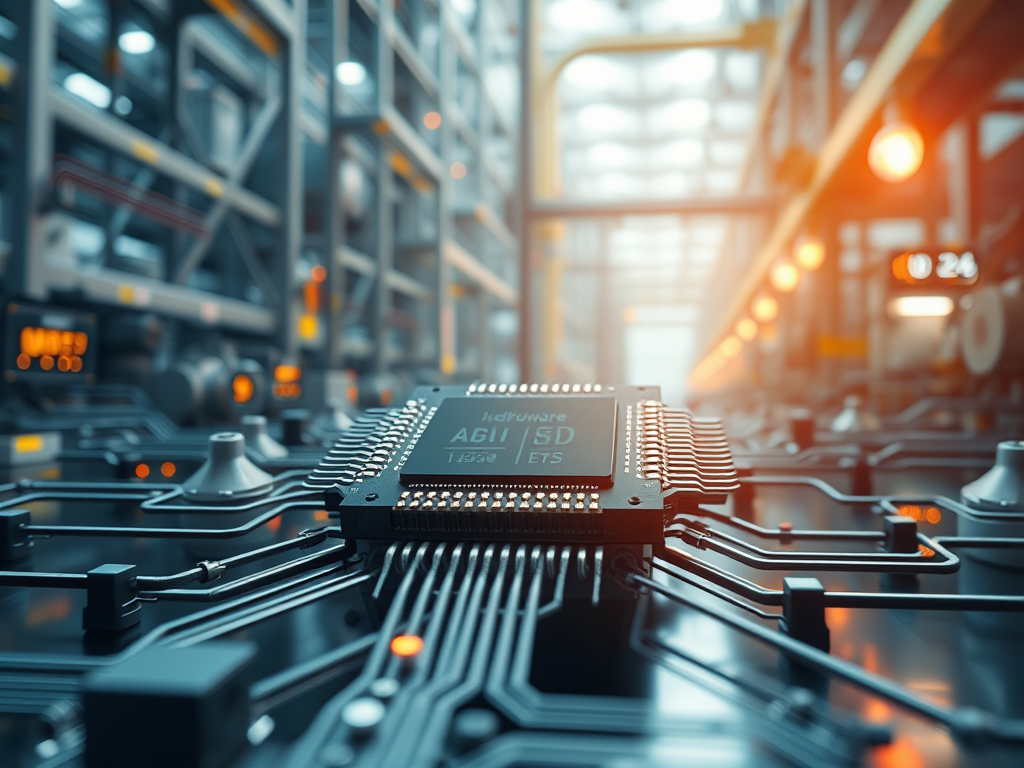
In human networks, trust is verified by credentials. In machine networks, it’s verified by cryptography. Each sensor must possess a hardware-rooted identity that can be attested before it’s allowed to communicate. That identity lives inside a secure element — a tamper-resistant microchip that stores cryptographic keys and certificates.
Infineon’s OPTIGA™ Trust M2 and NXP’s EdgeLock® SE05x families are examples: they generate keys on-chip, never expose them externally, and use elliptic-curve or post-quantum algorithms for authentication.
When integrated with Wibu-Systems’ CodeMeter, firmware and configuration files can be licensed and verified against these hardware anchors. The result: if a device isn’t authentic, it simply can’t run the code.
This is the industrial version of zero trust — zero assumption.
Security Chains, Not Security Islands
A factory is only as secure as its least trustworthy device. To scale hardware trust, manufacturers are adopting chain-of-trust architectures:
- Device provisioning — chips are programmed at manufacture with unique keys and certificates.
- Secure boot — firmware signatures are checked at startup.
- Mutual authentication — devices verify each other before exchanging data.
- Encrypted telemetry — data remains signed and verifiable from edge to cloud.
This continuous cryptographic lineage forms the backbone of Europe’s Gaia-X and Catena-X initiatives, where suppliers across the automotive and industrial sectors share data inside federated, identity-verified networks.
It’s not privacy for its own sake; it’s commercial survival through verifiable collaboration.
Example 1 – Bosch and the Authenticated Factory
Bosch Rexroth’s “Factory of the Future” platform deploys TPM-based controllers that attest identity at boot and sign every data packet they emit. Each robotic cell can prove not only that it’s genuine but also that its data hasn’t been tampered with en route to the cloud.
According to Bosch engineers, this approach reduced false maintenance alerts by 28 percent and simplified compliance audits under the Cyber Resilience Act (CRA).
Example 2 – Siemens Industrial Edge
At Siemens, hardware trust meets digital twin validation.Each edge device authenticates itself to a central model before participating in production simulation. If a machine’s identity or firmware hash deviates, it’s isolated automatically.
This fusion of digital twin governance and hardware attestation ensures that simulations reflect the real state of machines — a prerequisite for safe AI-assisted control.
Regulation Turns Design Into Law
Europe’s regulators have moved from guidance to enforcement.
- The NIS2 Directive mandates risk management for “essential entities,” including industrial automation.
- The Cyber Resilience Act requires built-in security and updateability for connected products, with explicit references to “trusted hardware components.”
- The forthcoming AI Act classifies safety-critical AI as “high-risk,” demanding technical transparency, which begins at the hardware layer.
This alignment makes hardware-anchored trust not just good practice but market access policy.
Beyond Encryption — Operational Assurance
Cryptography protects data; hardware trust protects behaviour. By fusing both, manufacturers can verify that every actuator command or sensor reading originates from an authenticated, untampered source.
Operationally, this means fewer safety recalls, simplified audits, and measurable compliance. Strategically, it means sovereignty: European industries depending on European chips, certified under European standards.
The Quantum Outlook
Quantum computing looms over industrial security as much as it does over finance. Long-life IoT devices installed today will still be operating when quantum decryption becomes practical.
Infineon, NXP and Wibu-Systems are already testing hybrid PQC implementations by combining classical ECC with NIST’s Kyber and Dilithium algorithms, ensuring that deployed sensors can survive the quantum transition via firmware update rather than replacement.
This forward compatibility turns hardware trust into long-term digital resilience.
TQS Takeaway
In the industrial internet, every sensor is both a storyteller and a potential liar. Hardware-anchored identity gives Europe’s machines a way to prove their honesty; mathematically, cryptographically, and operationally. Because in the factories of the future, the question won’t be who built it but who verifies it. And that answer, increasingly, will be etched directly into silicon.
Sources
- Infineon Technologies (2025). OPTIGA™ Trust M2 Product Brief.
- Wibu-Systems (2025). Secure Licensing for Industrial IoT and Edge Devices.
- Bosch Rexroth (2025). Factory of the Future Security Blueprint.
- Siemens (2025). Industrial Edge Device Authentication White Paper.
- European Commission (2025). NIS2 and Cyber Resilience Act Implementation Guidance.
- ENISA (2025). Trusted Hardware Components in IIoT Security Frameworks.
- NXP Semiconductors (2025). EdgeLock® SE05x Secure Element Datasheet.




Leave a Reply