
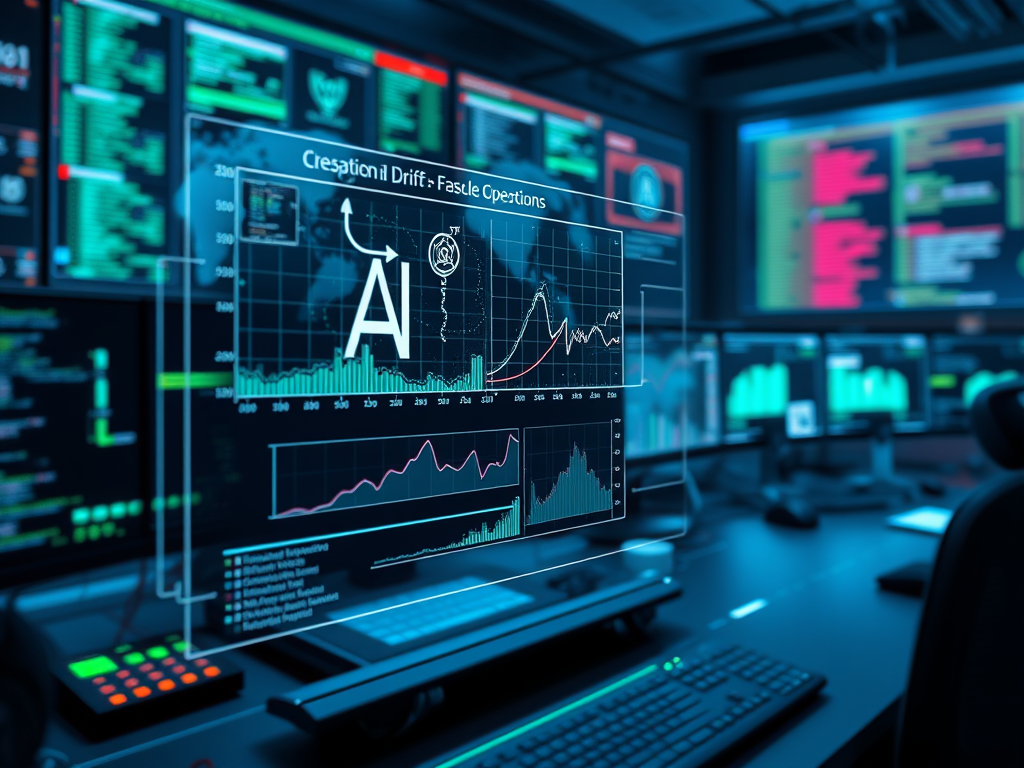
Model drift, false positives, automation risk, and the new failure modes of AI-driven security enforcement
AI and the Trust Layer (Part 4 of 5)
This article is part four of a five-part TQS series examining how artificial intelligence is moving from analytical tool to decision-making actor inside identity, security, and trust infrastructure — and what that shift means for control, accountability, and sovereignty.
For years, artificial intelligence in cybersecurity was positioned as an enhancement layer — a way to prioritise alerts, enrich telemetry, and help human analysts move faster. That phase is ending. AI is now increasingly deployed not just to inform security controls, but to act as one.
Systems automatically block transactions based on behavioural models. Accounts are locked due to anomaly scores. Network sessions are terminated by automated detection engines. Emails are quarantined by adaptive classifiers. Access decisions are adjusted dynamically based on behavioural baselines. In each case, AI is no longer advisory. It is enforcing.
This is a structural shift in how security architecture operates. And it introduces new failure modes that traditional control frameworks are not designed to handle.
Classic security controls are deterministic. A firewall rule matches or it does not. A certificate validates or it fails. A signature check passes or it breaks. When these controls fail, they usually fail in visible and diagnosable ways. Logs show rule hits. Configurations can be reviewed. Logic paths can be traced.
AI-driven controls behave differently. They operate on probabilities, thresholds, and pattern recognition. They are sensitive to data quality, environmental change, and training assumptions. Their decisions are shaped by statistical relationships rather than fixed logic. When they fail, they often fail gradually — and quietly.
One common failure mode is model drift. Behaviour changes over time — users adopt new work patterns, networks evolve, software usage shifts — and models trained on historical baselines become less accurate. What was once anomalous becomes normal, and what is dangerous begins to look familiar. Unless models are continuously validated and recalibrated, detection quality erodes while reported confidence scores remain stable. The dashboard stays green while reality turns amber.
False positives are another well-known but underestimated risk. All detection systems produce them, but AI-driven systems can generate them at scale and with high confidence scores. When automated enforcement is tied directly to those scores, legitimate users and transactions can be blocked systematically. Over time, organisations respond by lowering sensitivity or adding exceptions — which in turn creates blind spots. The control becomes politically tuned rather than risk tuned.
False negatives are more dangerous still, because they are invisible by definition. A model that fails to recognise a new attack pattern does not raise an alert — and automated systems built on top of that model take no action. If teams over-trust AI controls, human scrutiny decreases just as adversaries learn how to evade model features.
There is also an automation escalation risk. Many AI security tools are now connected to automated response playbooks: isolate the endpoint, revoke the token, block the account, terminate the session. This is efficient when correct — and disruptive when wrong. A misclassification can cascade into business interruption within seconds. Unlike a human analyst, an automated system does not pause when uncertain unless explicitly designed to do so.
Explainability is often presented as the remedy, but in operational security environments, explainability alone is not enough. Knowing which features influenced a model decision does not necessarily make that decision operationally auditable. Security controls must be reviewable, testable, and challengeable. That requires versioned models, reproducible scoring, preserved input context, and tamper-evident decision logs. Without those, post-incident analysis becomes speculative.
Data poisoning and adversarial manipulation add another layer of risk. Attackers do not need to break the model directly if they can influence its inputs or training signals. Carefully shaped behaviour can train systems to accept malicious patterns as normal. Synthetic noise can bury real signals. Feedback loops can be gamed. When AI becomes a control surface, it becomes a target surface.
Vendor opacity compounds the problem. Many AI security controls are delivered as managed or cloud-based services with limited visibility into model design, training data sources, and update cycles. Organisations may be enforcing decisions they cannot fully inspect. That is uncomfortable in any security context and especially problematic in regulated sectors where control justification is mandatory.
None of this means AI should not be used as a security control. In many environments, adaptive detection outperforms static rules and catches what signature systems miss. The mistake is not adoption — it is uncritical adoption.
AI controls must be governed like any other critical security mechanism. That means defined performance thresholds, independent validation, controlled update processes, rollback capability, and strong audit logging. It means separating detection confidence from enforcement authority where appropriate. It means designing human override paths that are real, not ceremonial.
Most importantly, it means recognising that AI controls are not magic. They are software components with statistical behaviour, dependency chains, and attack surfaces. Treating them as infallible because they are advanced is not innovation — it is operational negligence.
As AI takes on more direct enforcement roles, the centre of gravity shifts from detection accuracy to decision accountability. When an automated control blocks access, halts a transaction, or triggers an investigation, someone — and some system — must be able to justify why.
That leads directly to the final question in this series: when automated systems make trust and security decisions, who is actually accountable for the outcome?



Leave a Reply