
By Steve Atkins
On 25 February, the United Kingdom completed the rollout of its UK eVisa scheme, together with the broader Electronic Travel Authorisation (ETA) framework. At first glance this appears to be administrative modernisation — physical visa stickers and biometric residence permits replaced by digital records linked to a passport. Governments have digitised paperwork for decades, so the change risks sounding procedural rather than structural.
In reality, something more consequential occurred. The legal decision about entry into the country moved away from the physical frontier and into a system response that takes place before travel even begins.
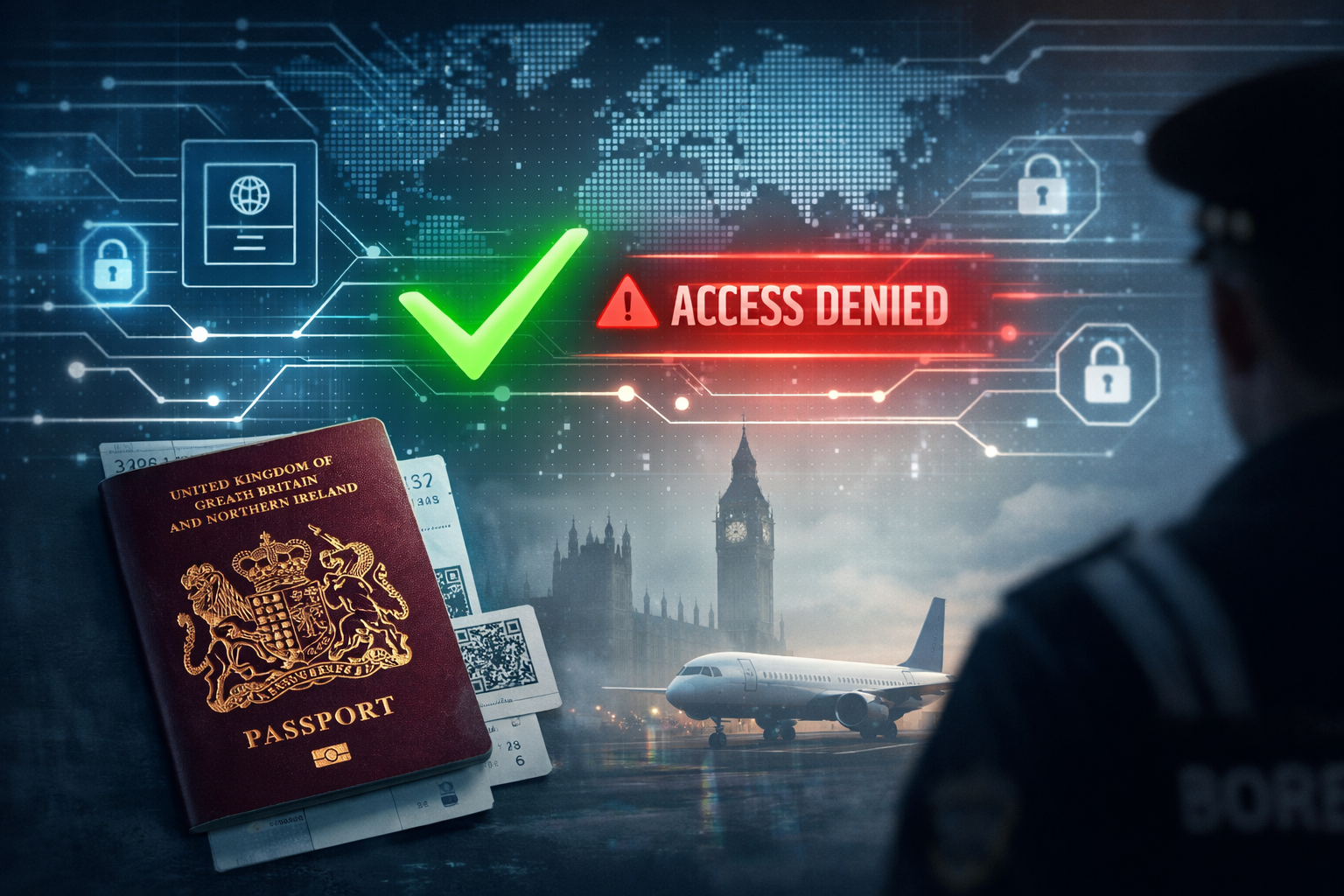
Under the UK eVisa model, immigration status exists only as a digital record. Airlines must verify that status prior to boarding. If the system returns a refusal, the journey never starts. There is no desk conversation, no presentation of supporting evidence, and no moment at which a border officer evaluates the circumstances in person. The determination happens upstream, and the physical border merely confirms what has already been decided elsewhere.
It is important to distinguish this from the United States’ long-standing Electronic System for Travel Authorization (ESTA). The US also requires travellers to obtain digital approval before departure, but the purpose is narrower: ESTA grants permission to travel in order to request admission. When a traveller arrives, a Customs and Border Protection officer still makes the legal decision at the border itself. The database informs the judgement; it does not replace it.
The UK approach goes a step further. The eVisa answers the admission question before the traveller ever reaches national territory. Airlines enforce that decision on behalf of the state. The officer, when encountered, verifies compliance rather than determining eligibility. In effect, the US digitised screening, while the UK has digitised admission.
For centuries, sovereign authority was exercised at a place. A person stood at a line on a map and interpreted documents presented by another person. Passports and visas functioned as evidence supporting a judgement made in context. Under the eVisa scheme, the document no longer contains the decision; it references a record, and the record carries the authority. The border has not disappeared, but it has relocated into infrastructure.
Once authority can be exercised without physical presence, geography stops being the moment of control. Movement becomes conditional on validation rather than inspection. The significance extends beyond immigration. Entry to a country is one of the clearest expressions of state power, and when that decision can occur remotely, the same logic applies naturally to other administrative permissions: the right to work, to access financial services, to receive benefits, to operate regulated activities, or to be restricted under sanctions regimes. Each is fundamentally a status decision expressed as data.
As status moves into systems, authority shifts from episodic encounters to continuous verification. The state no longer waits to meet the individual before acting. It determines eligibility and the physical world conforms to that determination. What appears to be a travel reform is therefore an operational change in governance: sovereign judgement executed as an infrastructure response.
The border still exists, but it is encountered earlier, invisibly and automatically. Travellers experience the consequence rather than the moment of decision. In practical terms, the United Kingdom has demonstrated that a core act of sovereignty can be performed as a network query answered in advance of presence.
The frontier has not vanished. It has become informational, and in doing so it reveals a broader transition: authority is no longer tied to location, but to validation within systems.
Steve Atkins is Editor and Publisher of The Quantum Space and CEO of Krowne Communications. He regularly comments on how identity, cryptography and automated systems are reshaping trust, markets and the practical exercise of authority in digital societies.




Leave a Reply