
The United Kingdom’s transition to a digital immigration status has not been a single-day change but a staged replacement of physical evidence with a persistent record.
Biometric Residence Permits began being phased out during 2024 as the Home Office encouraged holders to create online immigration accounts. Through 2025, visa holders were progressively moved to digital status records accessible through a government portal. From 25 February 2026, the system reached its operational point: permission to travel must be confirmed electronically before departure through the UK eVisa and Electronic Travel Authorisation (ETA) framework.
The change is often described as the removal of physical documents. Operationally, however, the significant difference is the order in which the decision occurs.
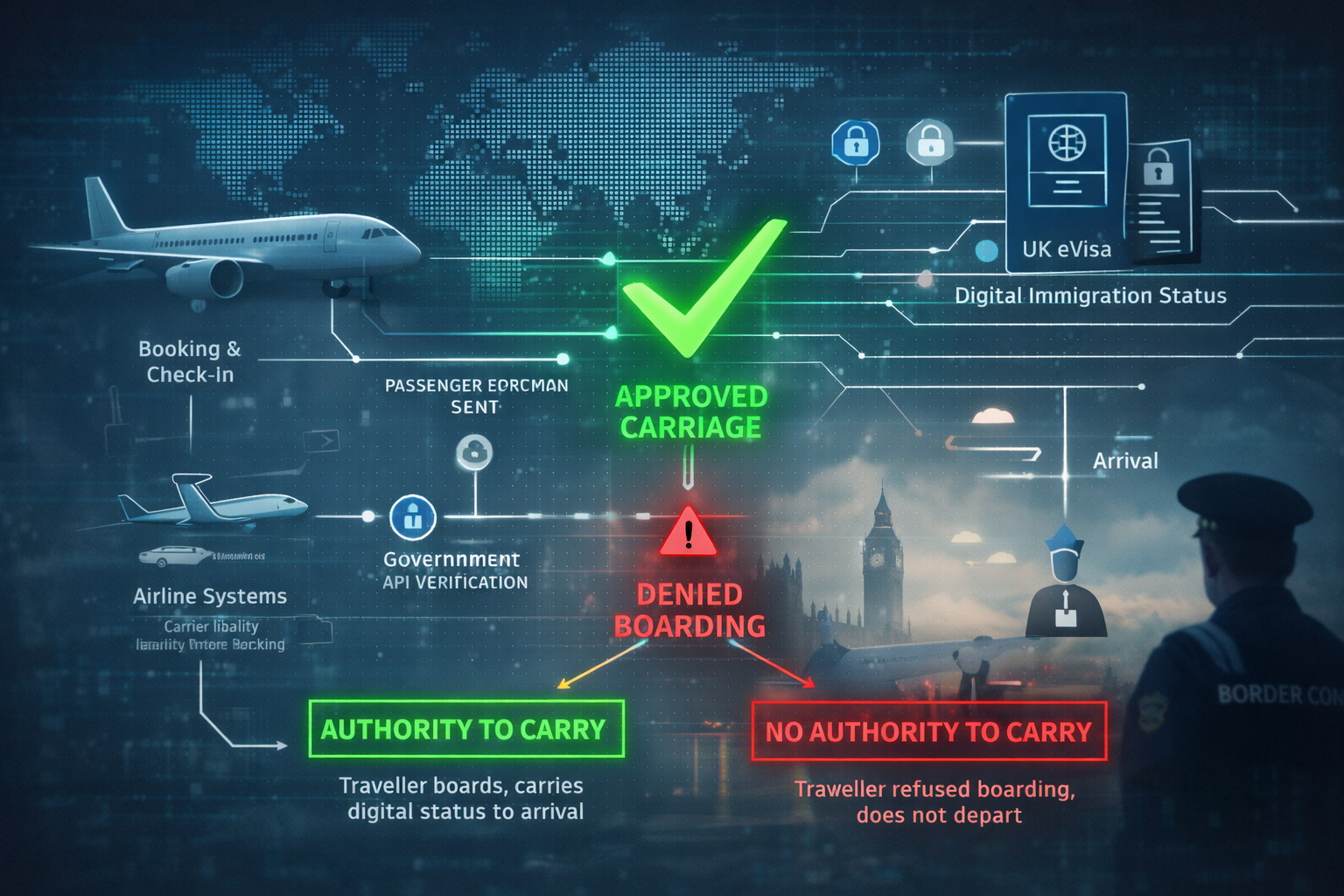
Airlines are now required to confirm immigration status before a passenger boards. Rather than inspecting a visa, the carrier submits passenger information and receives a boarding instruction from the government system. The response determines whether the journey can begin. If authorisation is not returned, the traveller never reaches the physical border.
This mechanism builds on an existing aviation practice known as carrier liability. Airlines have long been responsible for transporting only passengers eligible to enter the destination country. Previously this required visual inspection of passports and visas and, in uncertain cases, manual confirmation with border authorities. The digital process replaces interpretation with direct system validation.
The sequence follows a defined chain.
A passport number corresponds to a digital status record maintained by the Home Office. During check-in, passenger information is transmitted through Advance Passenger Information channels. The carrier receives an instruction — authority to carry or authority denied — before boarding is completed. The eligibility decision therefore occurs prior to movement.
Border officers remain present on arrival, but their role changes. Instead of determining eligibility, they verify that the arriving person matches the authorised record and that travel conditions are satisfied. The primary decision has already been made by the system that permitted travel.
Government communications have consistently framed the change as improving certainty for travellers and operators by ensuring status can be confirmed in advance rather than debated at the airport. Early operational feedback from airlines has focused on fewer document interpretation disputes but a greater dependence on system availability, as boarding decisions now rely entirely on connectivity to the verification service.
This distinguishes the approach from earlier pre-travel authorisation systems used internationally, which allow a traveller to request entry on arrival. The UK model determines whether the journey itself may occur.
From a technical perspective, the border becomes a process rather than a moment. Identity, status and permission are checked before departure and confirmed at arrival. The physical checkpoint remains, but it confirms a decision already taken elsewhere.
The practical effect is that the traveller encounters the consequence rather than the judgement. The border has not been removed; it has been reordered.


Leave a Reply