
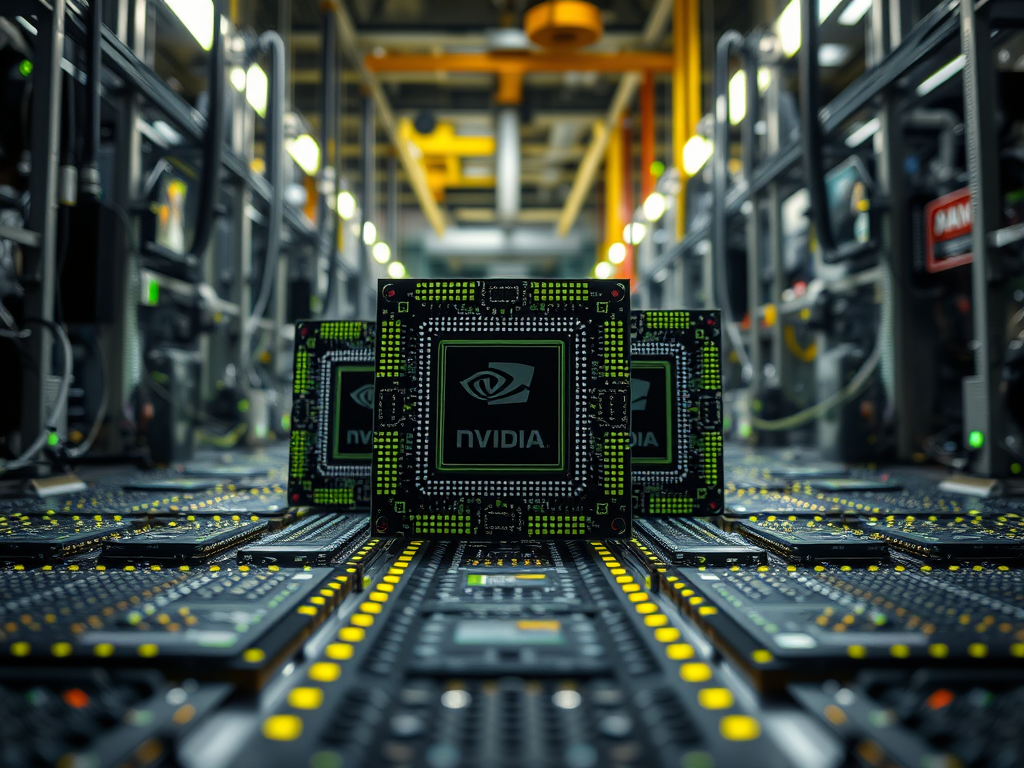
TSMC, Bottlenecks, and the Limits of AI Scale
When demand is no longer the constraint
Over the past weeks, reports have emerged that Chinese technology firms have placed extraordinarily large orders for Nvidia’s H200 AI accelerators. The scale is striking: estimates suggest demand running into the low millions of units for 2026 delivery, far exceeding Nvidia’s current inventory and near-term production capacity.
At first glance, this looks like another chapter in Nvidia’s remarkable AI growth story. But beneath the headlines sits a more sobering reality. Nvidia does not control its own production destiny — and neither, increasingly, do its customers.
The real story is not about orders.
It is about who can actually manufacture advanced AI silicon at scale, and how geopolitical constraints collide with physical limits in semiconductor fabrication.
Nvidia’s China demand spike: real, but conditional
China’s appetite for advanced AI compute has not diminished. Despite export controls, domestic substitution programmes, and rising investment in home-grown accelerators, Chinese hyperscalers and platform companies still see Nvidia’s architecture as the global performance benchmark.
The H200 — designed to remain compliant with evolving export rules — has become the focal point. Reports suggest that major Chinese players are prepared to commit tens of billions of dollars in future purchases if regulatory approvals and supply align.
However, these orders are not guaranteed revenue. They are contingent on three factors:
Export licensing clarity under US controls Chinese regulatory approval for imports Actual production capacity, which is the least flexible of the three
The third point is where the optimism quickly runs into physics.
The uncomfortable truth: Nvidia is fabless
Nvidia is a design powerhouse, not a manufacturer. Like most advanced semiconductor companies, it is fabless, outsourcing fabrication to foundry partners — overwhelmingly Taiwan Semiconductor Manufacturing Company (TSMC).
For leading-edge AI accelerators, this dependence is near total.
H200 chips rely on advanced 4-nanometre nodes They require high-bandwidth memory integration They depend on advanced packaging technologies, particularly TSMC’s CoWoS (Chip-on-Wafer-on-Substrate)
These capabilities exist at scale in very few places globally. Today, effectively, they exist at one.
CoWoS: the real bottleneck no one outside the industry talks about
While much attention is paid to wafer fabrication, the true choke point for AI accelerators is packaging.
Modern AI chips are not monolithic dies. They are complex assemblies combining logic dies, memory stacks, and interposers — all of which must be packaged with extreme precision. TSMC’s CoWoS process is currently the gold standard for this class of chip.
And CoWoS capacity is finite.
TSMC’s advanced packaging lines have been effectively sold out through much of 2025 and well into 2026. Nvidia, along with a small number of hyperscale customers, has secured a significant share of this capacity — but even Nvidia cannot absorb unlimited demand.
Every additional H200 unit competes directly with Nvidia’s own Blackwell generation Future architectures already in pre-production as well as other customers fighting for the same packaging slots.
This is not a temporary supply chain hiccup. It is a structural constraint.
Why “just ramp production” doesn’t work
Public statements often imply that production can simply be increased if demand is strong enough. In advanced semiconductors, that assumption is dangerously naïve.
Ramping H200 production requires:
- Additional wafer starts booked months in advance Mask sets and tooling reallocation
- Packaging capacity that cannot be created overnight
- Coordination across memory suppliers, substrates, and testing
Even with full cooperation from TSMC, meaningful capacity expansion is measured in quarters, not weeks.
Reports suggest Nvidia has asked TSMC to increase H200 output, with any meaningful uplift expected no earlier than mid-2026. Until then, supply remains tightly rationed.
Export controls add friction — not certainty
Overlaying this industrial reality is geopolitics.
Nvidia’s China-specific products exist precisely because of US export controls, which restrict performance thresholds, interconnect speeds, and memory configurations. Each revision of these rules forces product redesigns, re-qualification, and — critically — regulatory reassessment on the Chinese side.
This creates a paradox: China wants the chips Nvidia wants to sell them, TSMC can manufacture them, but no one can move quickly. Licensing delays, policy shifts, and compliance uncertainty all slow the flow, even when commercial incentives are aligned.
Strategic implications: concentration risk laid bare
The situation exposes a deeper vulnerability in the global AI ecosystem.
1. Foundry concentration: Advanced AI compute depends disproportionately on one foundry, one island, and a narrow set of processes. This is not an abstract geopolitical risk — it is a daily operational constraint.
2. Vendor dependence: For China, Nvidia remains difficult to replace at scale today. Domestic alternatives are improving rapidly, but gaps remain in performance, software ecosystems, and power efficiency.
3. Time as a strategic weapon: In advanced semiconductors, time is leverage. Whoever controls capacity allocation controls market outcomes — regardless of demand.
What this means for China’s domestic push
China’s response is predictable and already underway:
Accelerated investment in domestic AI accelerators Expanded funding for packaging and memory ecosystems Increased pressure to reduce dependence on foreign supply chains
However, closing the gap at the very top end of AI silicon is not trivial. It requires not just capital, but decades of accumulated process knowledge — particularly in advanced packaging.
In the interim, China faces a familiar trade-off: wait, ration, or substitute.
The bigger picture: AI scale meets physical limits
The Nvidia–China–TSMC triangle illustrates a broader shift in the AI era.
For years, the industry narrative assumed that compute could scale indefinitely as long as demand and capital existed. That assumption no longer holds.
We are entering a phase where:
- Manufacturing capacity, not algorithms, sets the pace
- Packaging technologies matter as much as transistor counts
- Geopolitics and industrial policy shape technical roadmaps
AI may be software-driven, but its limits are increasingly hardware-defined.
TQS takeaway
China’s massive Nvidia orders are real. TSMC’s production constraints are real. And the bottleneck between them is not easily resolved.
This is not a story about shortages in the traditional sense. It is a story about the finite nature of advanced manufacturing, and what happens when global demand converges on a single, irreplaceable capability.
In the AI age, compute is power — but capacity is control. And right now, capacity is the scarcest resource of all.


Leave a Reply