
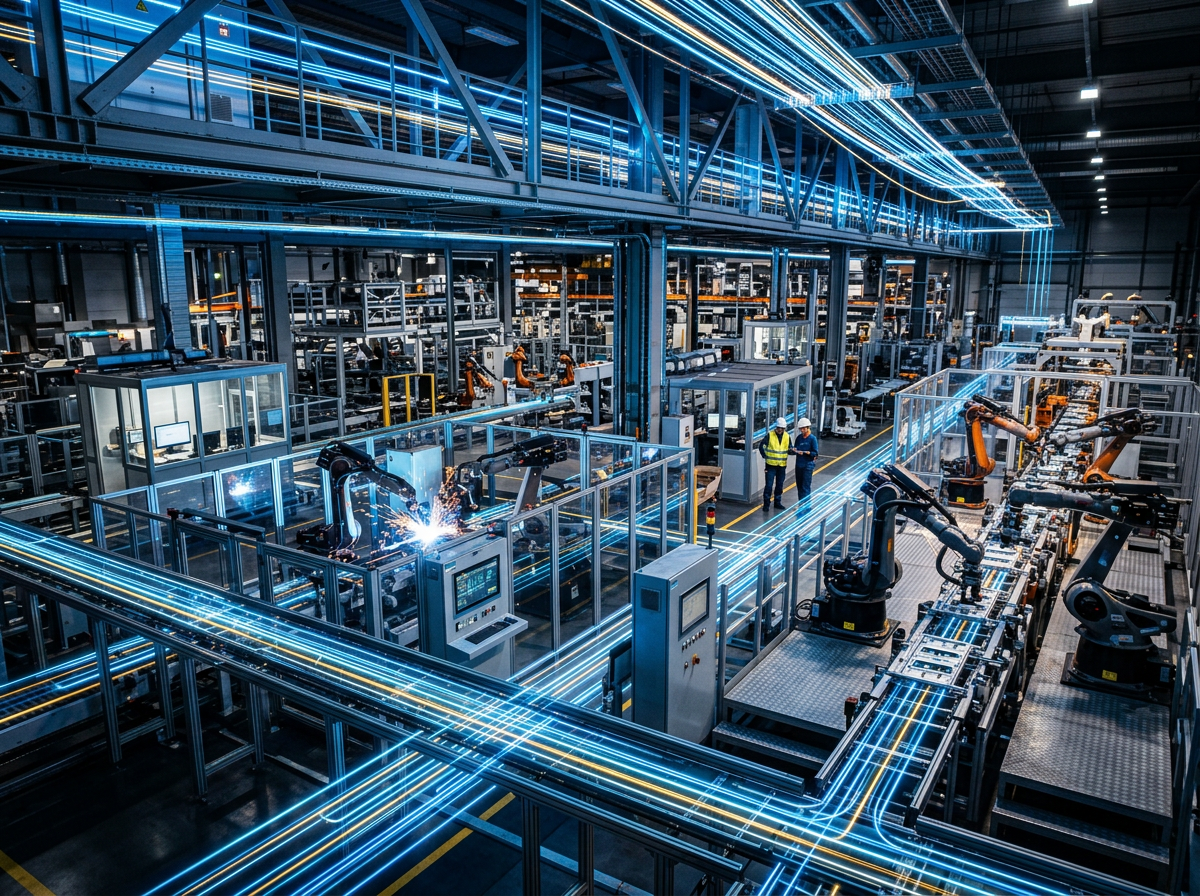
Industrial AI will transform manufacturing, but its success will depend on trust rather than intelligence alone.
This article is part of The Quantum Space’s Industrial Trust Stack series, examining how software, identity, artificial intelligence and security are becoming the foundation of the software-defined factory.
Artificial intelligence has become the defining technology story of the past three years. Most public discussion, however, has focused on consumer applications such as chatbots, image generation and digital assistants. These tools have introduced millions of people to AI, but they have also created an assumption that intelligence alone is the measure of success. In manufacturing, that assumption quickly breaks down.
Industrial AI operates in an environment where every decision carries operational consequences. A chatbot that produces an inaccurate response can usually be corrected with another prompt, but a quality inspection system that incorrectly rejects compliant products, a predictive maintenance platform that overlooks signs of equipment failure or an autonomous production system that acts on unreliable data can affect productivity, product quality and business continuity. The challenge is therefore not simply to make industrial AI more capable. It is to make it trustworthy.
This distinction explains why the conversation around artificial intelligence is changing. Manufacturers are no longer asking whether AI can improve efficiency or automate complex processes. Increasingly, they are asking whether automated decisions can be trusted as part of everyday operations. Confidence in artificial intelligence depends upon confidence in everything that surrounds it, from the authenticity of production data and the integrity of industrial software to the identity of connected machines and the resilience of the infrastructure on which those systems operate.
As manufacturing becomes increasingly software-defined, technologies such as industrial AI, edge computing, machine identity, software integrity and hardware roots of trust are becoming interconnected rather than independent investments. Artificial intelligence relies upon trusted software, trusted software depends upon secure hardware, connected machines require verified identities and every automated decision depends upon reliable operational data. These technologies do not solve separate problems. Together they establish the conditions in which intelligent manufacturing becomes possible.
Much of today’s discussion continues to focus on model performance, processing power and increasingly sophisticated algorithms. These developments are important, but they represent only part of the industrial challenge. Manufacturers must also establish confidence that software has not been modified, that connected devices are authentic, that production data has not been compromised and that automated decisions can be validated, audited and understood. Without that foundation, artificial intelligence becomes another source of operational risk rather than operational advantage.
This broader perspective also changes the role of cybersecurity. Protecting industrial environments is no longer confined to defending networks or preventing unauthorised access. Security increasingly becomes an enabling technology that allows organisations to deploy artificial intelligence with confidence. Software integrity, machine identity, secure updates and hardware roots of trust move beyond technical specialisms and become essential components of modern industrial engineering. Together they form part of the Industrial Trust Stack introduced in our previous article and illustrate why trust is becoming the defining architecture of the software-defined factory.
The future of manufacturing will undoubtedly be shaped by artificial intelligence, but intelligence alone will not determine which organisations succeed. The competitive advantage will belong to manufacturers that establish confidence in the software, systems and data that support every automated decision. In industrial environments, trust is not an additional feature layered on top of artificial intelligence. It is the engineering discipline that allows artificial intelligence to operate safely, reliably and at scale.
Continuing the Conversation at INNO Days
The themes explored in this article will continue at INNO Days 2026, where The Quantum Space will interview industry leaders and moderate a roundtable examining software integrity, operational resilience and digital trust across modern manufacturing.


Leave a Reply