

Entangled in Narrative, Still Separate in Practice
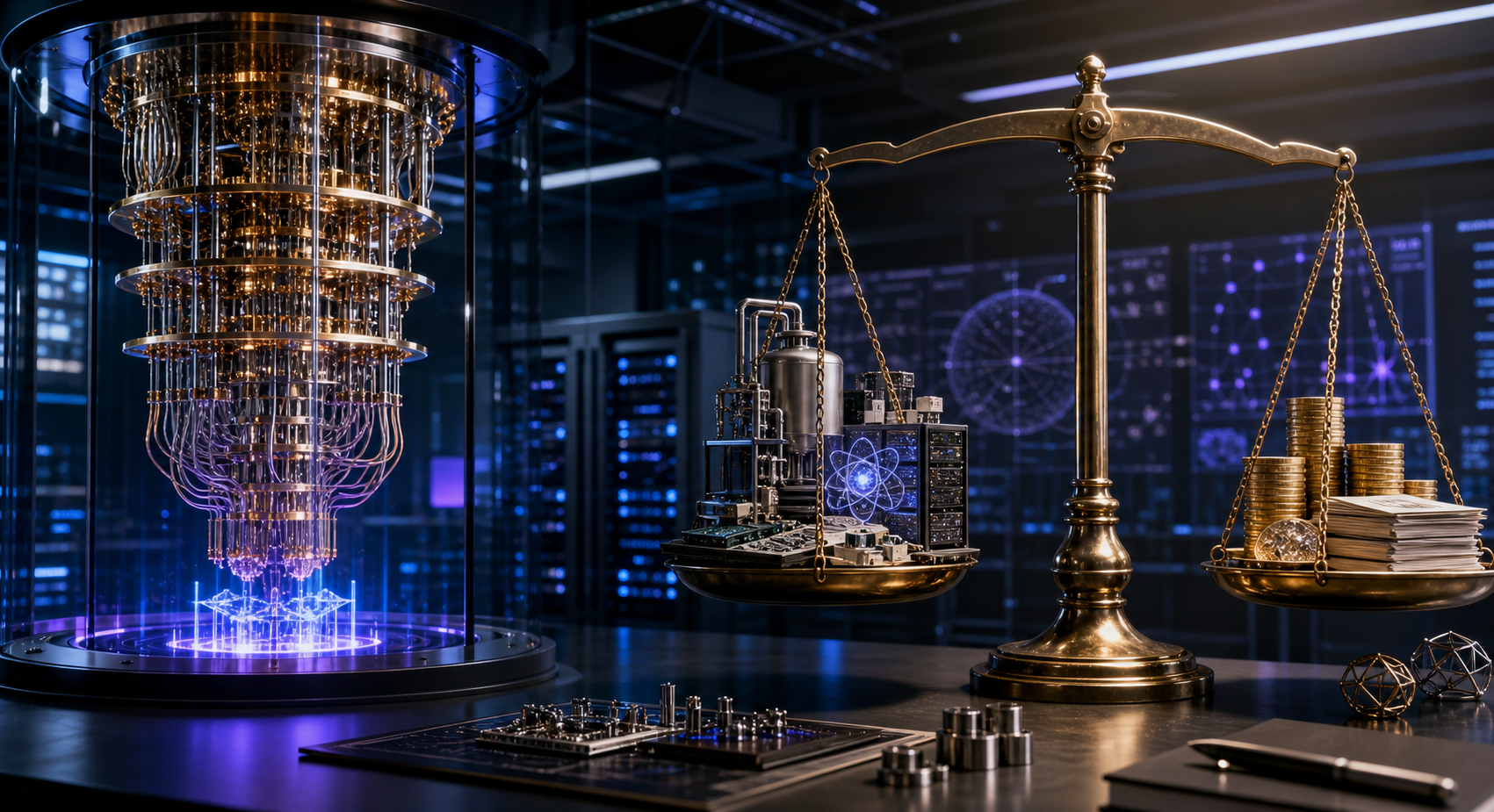
The convergence of quantum computing and artifcial intelligence is one of the most discussed themes in deep technology today. It is also one of the most mischaracterised. For organisations making infrastructure decisions now, the distinction between what is happening and what is being anticipated matters considerably.
There is a version of the quantum-AI convergence story that is real, substantiated, and accelerating. There is another version that is largely aspirational, running several years ahead of the hardware and infrastructure conditions needed to make it operational at enterprise scale. Both versions appear frequently in the same conference presentations, the same analyst briefings, and sometimes the same paragraphs.
The question worth asking is not whether quantum and AI will converge. They will, and the technical foundations for that convergence are increasingly clear. The more useful question is what specific conditions must be met before that convergence becomes something organisations can plan around rather than simply monitor.
What is actually converging right now
The clearest evidence of genuine convergence in 2026 is not quantum-enhanced AI models. It is AI-assisted quantum hardware. The relationship, for now, runs primarily in one direction: classical machine learning is being used to make quantum systems more reliable, more efficient, and more tractable to operate.
Error correction is the most signifcant example. Quantum systems are inherently noisy. Maintaining qubit coherence long enough to complete meaningful computations has been the central engineering challenge for the past decade. AI-based error correction and noise modelling are now making measurable contributions to addressing that challenge. This is not theoretical. It is in production at IBM, Google, and Quantinuum, among others.
Separately, AI is being applied to quantum circuit optimisation, pulse-level calibration, and the design of quantum algorithms themselves. These are operational contributions, and they are compressing the timeline for achieving reliable quantum computation.
The clearest evidence of genuine convergence in 2026 is not quantum-enhanced AI models. It is AI- assisted quantum hardware. The relationship, for now, runs primarily in one direction.
In October 2025, Google demonstrated a 13,000-fold speedup over the Frontier supercomputer for a specific physics simulation task using 65 qubits. In early 2026, a joint research team published results using a 1,200-qubit processor to execute neural architecture search tasks in hours rather than weeks. These are meaningful demonstrations. They are also narrowly scoped, task-specifc, and not yet reproducible across general enterprise workloads.
IBM has set 2026 as its target year for demonstrating practical quantum advantage — the point at which a quantum system solves a problem beyond the reach of any classical method. Whether that milestone arrives on schedule or slips by a quarter or two, the direction is unambiguous.
Where the gap remains wide
For most organisations, the honest assessment is that quantum- enhanced AI remains a research-adjacent activity rather than a deployment-ready capability. Several speci@c gaps explain why.
Scale and qubit quality. Today’s best quantum processors operate at between 65 and 1,000+ physical qubits depending on architecture. Fault-tolerant quantum computation — the kind required for sustained, reliable performance on complex AI workloads — is estimated to require millions of high-quality logical qubits. Physical qubit counts are rising, but the error rates on those qubits mean that many physical qubits must be devoted to error correction for each logical qubit that emerges. The arithmetic is still unfavourable for general-purpose use.
Coherence time. Quantum systems must maintain their quantum state long enough to complete a computation. Current coherence times, measured in microseconds to milliseconds depending on the architecture, limit the depth of circuits that can be reliably executed. AI workloads, particularly training and inference tasks involving large parameter spaces, require far more sustained computation than current coherence windows allow.
Hybrid infrastructure immaturity. The practical near-term path for quantum-AI involves hybrid classical-quantum architectures, where quantum co-processors handle specific optimisation or sampling tasks while classical systems manage the broader computation. This architecture is operationally sound in principle. The middleware, orchestration tooling, and integration frameworks to make it work reliably at enterprise scale are still early-stage. Organisations that attempted hybrid pilots in 2025 frequently encountered friction at the integration layer rather than the quantum layer itself.
Workforce and tooling gaps. Deploying quantum-enhanced AI workloads requires capabilities that do not yet exist at scale in most organisations: quantum software engineers, hybrid algorithm designers, and teams fluent in both quantum mechanics and machine learning. The talent pool is growing but remains concentrated in research institutions and a small number of technology companies.
THE STRUCTURAL REALITY
The barriers to quantum-AI convergence are not primarily theoretical. The physics is understood. The algorithmic approaches are known. What is missing is infrastructure maturity: the reliability, scalability, and integration tooling that transforms a laboratory-demonstrated capability into an enterprise-deployable system.
Organisations that understand this distinction are better positioned to make decisions about when and how to engage — rather than either dismissing the field as distant or over-investing in capabilities that cannot yet be operationalised.
What the infrastructure needs to deliver
The convergence question, reframed through an infrastructure lens, becomes more tractable. Rather than asking when quantum AI will arrive, organisations benefit from tracking progress against specific technical and systemic conditions. The following represent the clearest milestones on the path from research demonstration to operational capability.
| DOMAIN | REQUIREMENT |
|---|---|
| Hardware | Fault-tolerant logical qubits at scale Progress from physical to logical qubits with error rates below 10˗6 per gate operation. Requires physical qubit counts in the millions for meaningful workloads. Microsoft’s topological qubit work and Quantinuum’s trapped-ion systems are tracking toward this; timeline remains 3–7 years for broad availability. |
| Coherence | Sustained coherence at computation-relevant timescales Extending coherence windows from milliseconds to seconds, and eventually minutes, to support deeper quantum circuits. This is an active area of materials science and cryogenic engineering research, not a solved problem. |
| Integration | Mature hybrid orchestration middleware Production-grade tooling for routing workloads between classical HPC and quantum co- processors, with latency, reliability, and security guarantees comparable to existing cloud infrastructure. Currently fragmented across proprietary and open-source projects with limited interoperability. |
| Algorithms | Quantum-native ML algorithms with demonstrated classical advantage Beyond narrow demonstration tasks, generalised algorithms for quantum machine learning — variational circuits, quantum sampling, quantum generative models — need to show consistent, reproducible advantage over optimised classical baselines at practically relevant problem sizes. |
| Access | Cloud quantum access with enterprise-grade SLAs IBM Quantum, AWS Braket, Azure Quantum, and Google Quantum AI all offer cloud access today. The gap is in reliability, uptime, queue times, and security guarantees required for production enterprise workloads. This is an infrastructure and commercial maturity gap as much as a technical one. |
| Talent | Workforce capable of operating hybrid systems A generation of quantum-fluent engineers who can design, optimise, and maintain hybrid quantum-classical pipelines. University programmes are expanding; enterprise training is nascent. The shortage will be a bottleneck before the hardware is. |
The domains where convergence arrives first
Not all AI workloads are equally positioned to benefit from quantum acceleration, and not all industries will see the impact at the same time. The earliest and clearest cases are those where the problem structure is inherently quantum-amenable: optimisation over exponentially large solution spaces, molecular and chemical simulation, and probabilistic sampling.
Drug discovery and materials science sit at the front of the queue. The simulation of molecular interactions is a problem that classical computers approximate through increasing computational cost. Quantum systems can, in principle, model these interactions exactly. This is the use case that most directly aligns quantum capability with AI-driven discovery workflows, and multiple pharmaceutical and materials companies are running active pilots.
Financial optimisation is a second early domain. Portfolio construction, risk modelling, and derivatives pricing involve optimisation problems across vast parameter spaces. Quantum- enhanced sampling and optimisation algorithms — even in hybrid configurations — have the potential to identify solutions that classical methods miss or find only after prohibitive compute cost.
Supply chain and logistics follow a similar logic. The combinatorial complexity of large-scale routing, scheduling, and inventory optimisation maps well to quantum optimisation approaches. Early pilots are underway, though the advantage over classical solvers at current qubit quality remains narrow.
The quantum-AI convergence does not need to be universal to be consequential. It needs to be decisive in a small number of high-value domains where the economics justify the infrastructure investment.
This pattern — selective advantage in specific problem classes, in specific industries, ahead of general availability — is how practically every major computing transition has unfolded. Organisations that map their own workloads against these early-converging domains are better positioned than those waiting for a universal signal.
The hybrid architecture is not a compromise. It is the strategy.
One of the most persistent misconceptions in discussions of quantum-AI convergence is that the hybrid classical-quantum model is a transitional arrangement to be tolerated until fully fault-tolerant quantum systems arrive. The evidence suggests otherwise.
The architecture of AI infrastructure is already heterogeneous. GPUs handle training workloads. TPUs and custom ASICs manage inference at scale. FPGAs and analog inference chips are emerging for edge deployment. The model has never been a single compute paradigm for all tasks. Quantum co-processors fit naturally into this architecture as specialised accelerators for tasks they are suited to handle — not as replacements for any existing layer.
IBM, AMD, and several hyperscale cloud providers are already exploring integration of quantum processors alongside CPUs, GPUs, and FPGAs within unified compute environments. The framing of quantum as a separate, distant capability — something to be evaluated independently of existing infrastructure decisions — is becoming progressively less accurate.
For organisations planning data centre and cloud strategy over a five-to-ten-year horizon, the question is not whether to include quantum in that planning. It is how to structure the planning so that quantum integration is an additive upgrade rather than a disruptive redesign.
What executives should be doing now
The appropriate organisational response to quantum-AI convergence is neither urgency nor dismissal. It is structured preparation. There are three areas where action now produces compounding returns.
Workload mapping. Identify which of your organisation’s computationally intensive AI and optimisation workloads have characteristics — large combinatorial search spaces, molecular or materials simulation, probabilistic inference at scale — that align with quantum-amenable problem classes. This is not a commitment to deployment. It is an inventory of where quantum acceleration, when available, would deliver the most value.
Pilot infrastructure. Cloud-based quantum access is available today through IBM Quantum, AWS Braket, and Azure Quantum. Running structured experiments on real hardware, even at current capability levels, builds institutional knowledge at a fraction of the cost of deploying on legacy hardware. Organisations that understand quantum systems through hands-on experience will adapt faster when the technology matures.
Talent positioning. The shortage of quantum-literate engineers will precede the hardware maturity gap. Begin identifying candidates with quantum computing backgrounds for key research and infrastructure roles, and invest in upskilling programmes for existing data science and ML engineering teams. The organisations that lead in quantum-AI deployment in 2028 and beyond will be those that built their teams in 2025 and 2026.
The convergence is structural, not spectacular
There will not be a single announcement or product release that marks the moment quantum and AI converge. The transition will look more like what we have observed across Q1 2026: incremental hardware advances, expanding hybrid pilots, growing middleware maturity, and a slow but consistent shift in the problem classes where quantum systems deliver demonstrable value.
The narrative of entanglement between these two fields is accurate at the level of trajectory. What it is not, yet, is operational at the level of deployable enterprise systems. That distinction is not a reason for inaction. It is a reason for the kind of deliberate, structured preparation that separates organisations that lead technology transitions from those that are forced to respond to them.
The systems are moving. The infrastructure is not yet ready. By the time quantum-enhanced AI becomes operationally obvious, the organisations positioned to exploit it will already have spent years adapting their infrastructure, tooling, and workforce.



Leave a Reply