
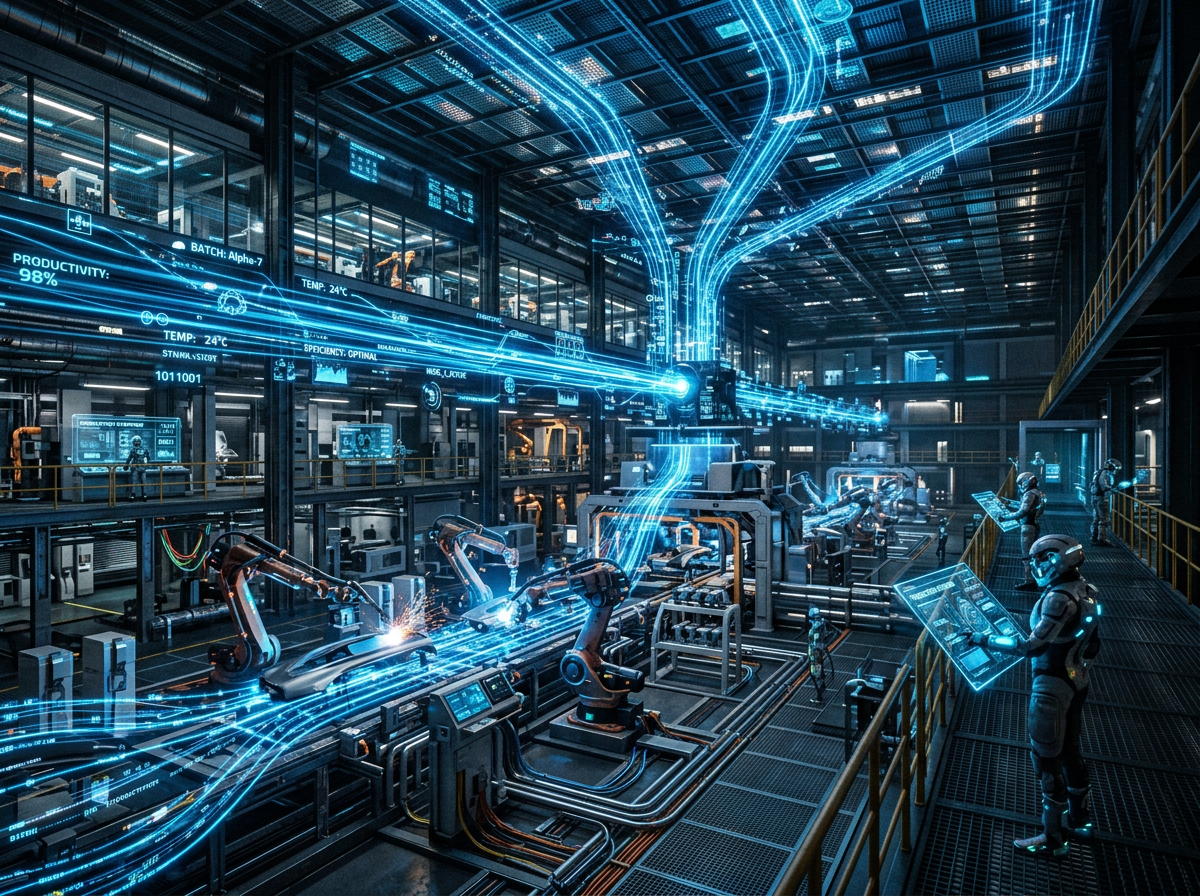
Operational technology is evolving beyond control systems to become the trust architecture of the software-defined factory.
This article is part of The Quantum Space’s Industrial Trust Stack series, examining how software, identity, artificial intelligence and security are becoming the foundation of the software-defined factory.
Operational technology has traditionally been judged by three characteristics: reliability, availability and safety. Industrial control systems were designed to keep production running, minimise downtime and ensure predictable operation. Security was important, but it was generally viewed as a protective layer around the factory rather than an integral part of its operation. That distinction is now disappearing.
As manufacturing becomes increasingly software-defined, operational technology is evolving beyond the systems that control industrial processes. It is becoming the environment in which software, connected machines, artificial intelligence and automated decision-making establish trust. The question is no longer simply whether a production line continues to operate. It is whether every system contributing to that operation can be trusted.
This shift reflects the growing complexity of modern manufacturing. Production equipment no longer operates in isolation. Machines exchange information continuously, edge computing platforms process operational data in real time, industrial AI contributes to quality inspection and predictive maintenance, while suppliers, cloud services and digital twins increasingly become part of the manufacturing process itself. The result is an operational environment where every connection introduces another requirement for confidence.
Trust therefore moves from the perimeter into the production environment.
Industrial organisations must establish confidence that connected devices are genuine, that software has not been modified, that operational data remains authentic and that automated decisions are based upon reliable information. Software integrity, machine identity, secure updates and hardware roots of trust are no longer independent security disciplines. Together they become essential characteristics of operational technology itself.
This represents a significant change in how industrial cybersecurity should be understood. For many years the objective was to protect operational technology from external threats. Today the objective is broader. Operational technology increasingly provides the trust architecture upon which modern manufacturing depends. It becomes the layer that allows software, data and artificial intelligence to operate with confidence across increasingly connected industrial environments.
Viewed in this way, operational technology is no longer simply another technology domain. It becomes one of the defining layers within the Industrial Trust Stack introduced earlier in this series. Artificial intelligence cannot be deployed with confidence unless operational technology establishes trusted communications. Software integrity has little value if connected devices cannot authenticate one another. Digital trust emerges not from any single technology, but from the way these capabilities operate together.
The software-defined factory will undoubtedly continue to become more autonomous over the coming decade. That autonomy, however, will depend upon operational technology evolving from a control platform into a trust platform. Manufacturers that recognise this shift will be better positioned to deploy industrial AI, protect intellectual property and build resilient production environments capable of supporting the next generation of digital manufacturing.
Continuing the Conversation at INNO Days
The themes explored in this article will continue at INNO Days 2026, where The Quantum Space will interview industry leaders and moderate a roundtable examining software integrity, operational resilience and digital trust across modern manufacturing.




Leave a Reply