
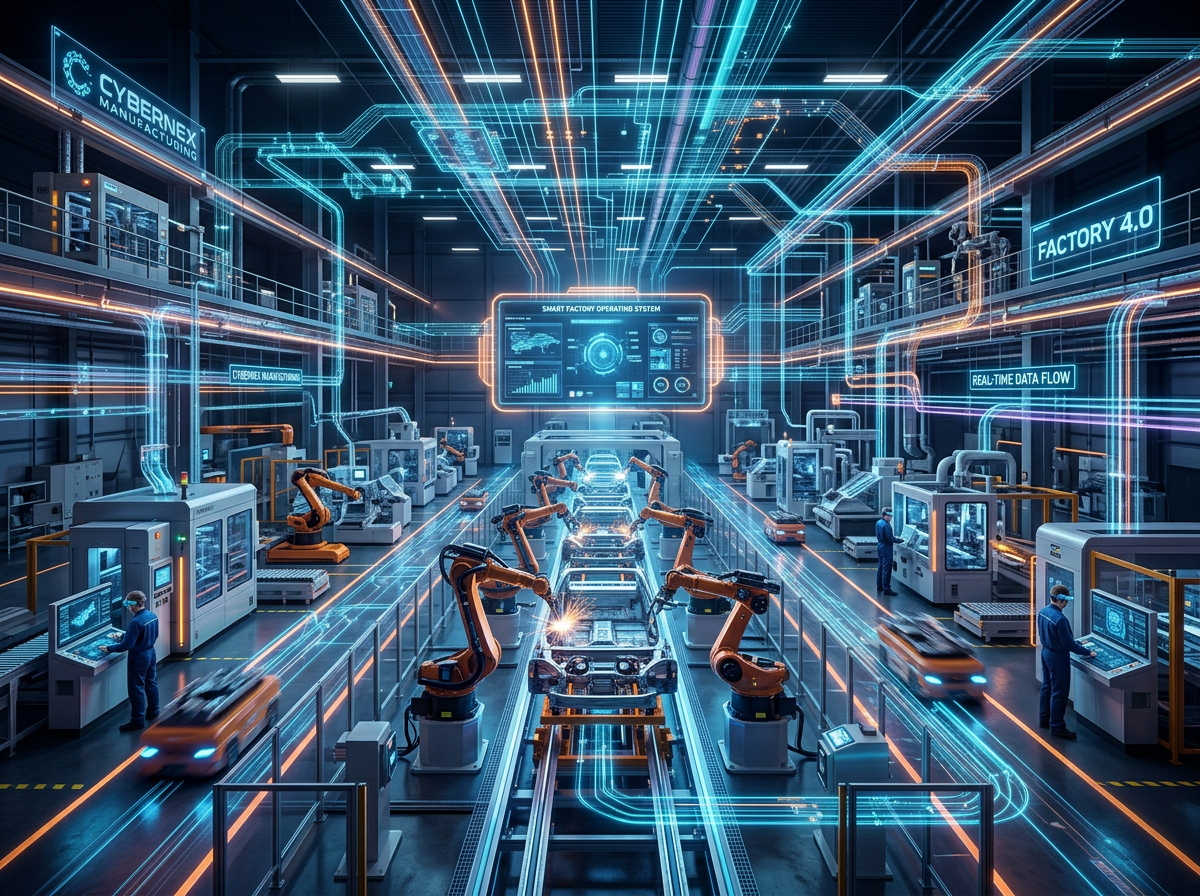
As manufacturing becomes increasingly connected, trusted machine identity is becoming a fundamental requirement for the software-defined factory.
This article is part of The Quantum Space’s Industrial Trust Stack series, examining how software, identity, artificial intelligence and security are becoming the foundation of the software-defined factory.
For decades, digital identity has largely been associated with people. Employees authenticate themselves to corporate networks, customers log into online services and governments issue trusted digital credentials. Identity has traditionally answered one simple question: who are you?
The software-defined factory asks a different question. How do machines recognise one another? Modern manufacturing increasingly depends upon thousands of connected assets exchanging information continuously. Industrial robots communicate with production systems, sensors provide operational data, edge computing platforms analyse information locally and artificial intelligence increasingly contributes to automated decision-making. Every interaction assumes that the systems involved are genuine, authorised and operating exactly as intended.
Identity therefore becomes an engineering requirement rather than an administrative function.
The importance of this shift is often overlooked because machine identity operates quietly in the background. Unlike passwords or user accounts, trusted identities for industrial devices are rarely visible to production teams. They are established through certificates, cryptographic credentials, hardware roots of trust and secure provisioning processes that allow systems to authenticate one another automatically throughout their operational lifecycle.
As manufacturing continues to evolve, this capability becomes increasingly significant. Connected devices cannot safely exchange operational data unless their identities can be verified. Artificial intelligence cannot reliably automate decisions if the information it receives originates from unknown or compromised systems. Software updates cannot be trusted unless both the software itself and the device receiving it can be authenticated before deployment.
Machine identity therefore extends well beyond cybersecurity. It establishes the confidence upon which software-defined manufacturing depends.
This illustrates an important characteristic of the Industrial Trust Stack. None of its individual technologies deliver trust independently. Machine identity supports software integrity. Software integrity strengthens operational resilience. Hardware roots of trust protect digital credentials. Artificial intelligence depends upon each of these capabilities before organisations can confidently automate critical processes. Trust emerges from the relationship between these technologies rather than from any single component.
For manufacturers, the implications are becoming increasingly clear. As industrial environments become more connected, every new device represents another digital participant within the production process. Managing those devices increasingly resembles managing users within an enterprise network, except the identities now belong to machines operating continuously across complex industrial environments.
Manufacturing has always depended upon precision but now, the software-defined factory depends upon identity.
That distinction helps explain why digital identity is moving beyond enterprise IT and becoming one of the defining engineering disciplines of modern industrial systems. The organisations that establish trusted identities across their industrial infrastructure will be better positioned to deploy artificial intelligence, secure software and build resilient manufacturing environments capable of supporting the next generation of industrial innovation.
Continuing the Conversation at INNO Days
The themes explored in this article will continue at INNO Days 2026, where The Quantum Space will interview industry leaders and moderate a roundtable examining software integrity, operational resilience and digital trust across modern manufacturing.




Leave a Reply