
Industrial resilience is not simply about preventing a factory shutdown. It is about restoring production safely, recovering critical systems and understanding the software dependencies that can determine whether manufacturing can restart at all.
MModern manufacturing depends on interconnected production systems, operational technology, software licensing and increasingly complex digital supply chains. While these connections have improved efficiency and flexibility, they have also created dependencies that can complicate industrial recovery. When a factory experiences a disruption, restoring individual machines or networks is only part of the challenge. The real question is whether production can restart safely, with trusted systems, functioning software and the necessary operational controls in place.

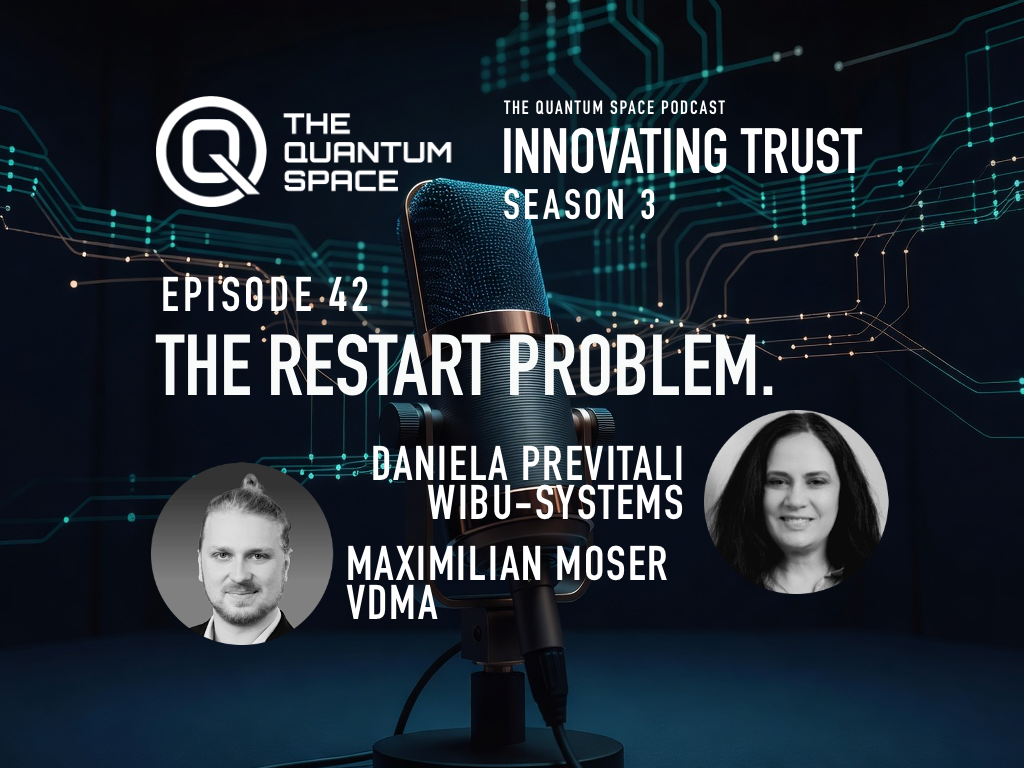
In Episode 42 of Innovating Trust, Steve Atkins examines what industrial resilience really means when the immediate crisis is over and the pressure to restart begins. With contributions from Maximilian Moser of VDMA and Daniela Previtali of Wibu-Systems, the discussion explores the practical challenges of recovery, from network dependencies and incident-response exercises to software licensing, emergency access and operational continuity.
A real-world example involving industrial cutting machines illustrates how carefully designed recovery mechanisms can allow production to resume even when normal licensing arrangements are unavailable. But technical recovery is only part of the story. Software versions, system integrity, credentials, production data and safety checks all need to be considered before operations can safely resume.
As manufacturers introduce more automation, edge intelligence and connected services, the ability to recover becomes just as important as the ability to prevent disruption.
The real measure of resilience is not simply whether a factory can be stopped safely, but whether it can be restarted with confidence.
Stopping a factory safely is one challenge. Bringing it back into production, with trusted systems, working software and clear responsibility, is quite another.
Modern manufacturing depends on increasingly interconnected systems, shared services and digital supply chains. These connections have made production more efficient, but they have also introduced dependencies that can turn a relatively small disruption into a factory-wide shutdown. And when production stops, restoring individual systems is not necessarily the same as being ready to manufacture again.
What makes restarting a factory after a disruption difficult?
Restarting a factory involves more than restoring power or reconnecting machinery. Manufacturers must verify software versions, recover licences, check credentials and connectivity, and establish that affected systems are safe to operate. Industrial resilience depends on preparing these recovery processes before a disruption occurs.
How does software licensing affect industrial business continuity?
Industrial software licences may be tied to specific machines or systems. When equipment fails or software must be transferred, unavailable licences can delay production recovery. Self-service licence restoration, emergency licensing and carefully designed recovery procedures can reduce this dependency while maintaining software protection.
In Episode 42 of Innovating Trust, Steve Atkins examines what industrial resilience really means when the immediate crisis is over and the pressure to restart begins. With contributions from Maximilian Moser of VDMA and Daniela Previtali of Wibu-Systems, the discussion explores the practical challenges of recovery, from network dependencies and incident-response exercises to software licensing, emergency access and operational continuity.
A real-world example involving industrial cutting machines illustrates how carefully designed recovery mechanisms can allow production to resume even when normal licensing arrangements are unavailable. But technical recovery is only part of the story. Software versions, system integrity, credentials, production data and safety checks all need to be considered before operations can safely resume.
As manufacturers introduce more automation, edge intelligence and connected services, the ability to recover becomes just as important as the ability to prevent disruption.
The real measure of resilience is not simply whether a factory can be stopped safely, but whether it can be restarted with confidence.
The Quantum Space: Innovating Trust is recognised by MillionPodcasts as one of the Top 20 Cryptography Podcasts : view the list here
Listen to ‘Innovating Trust’ on your regular Podcast platform;




Leave a Reply