
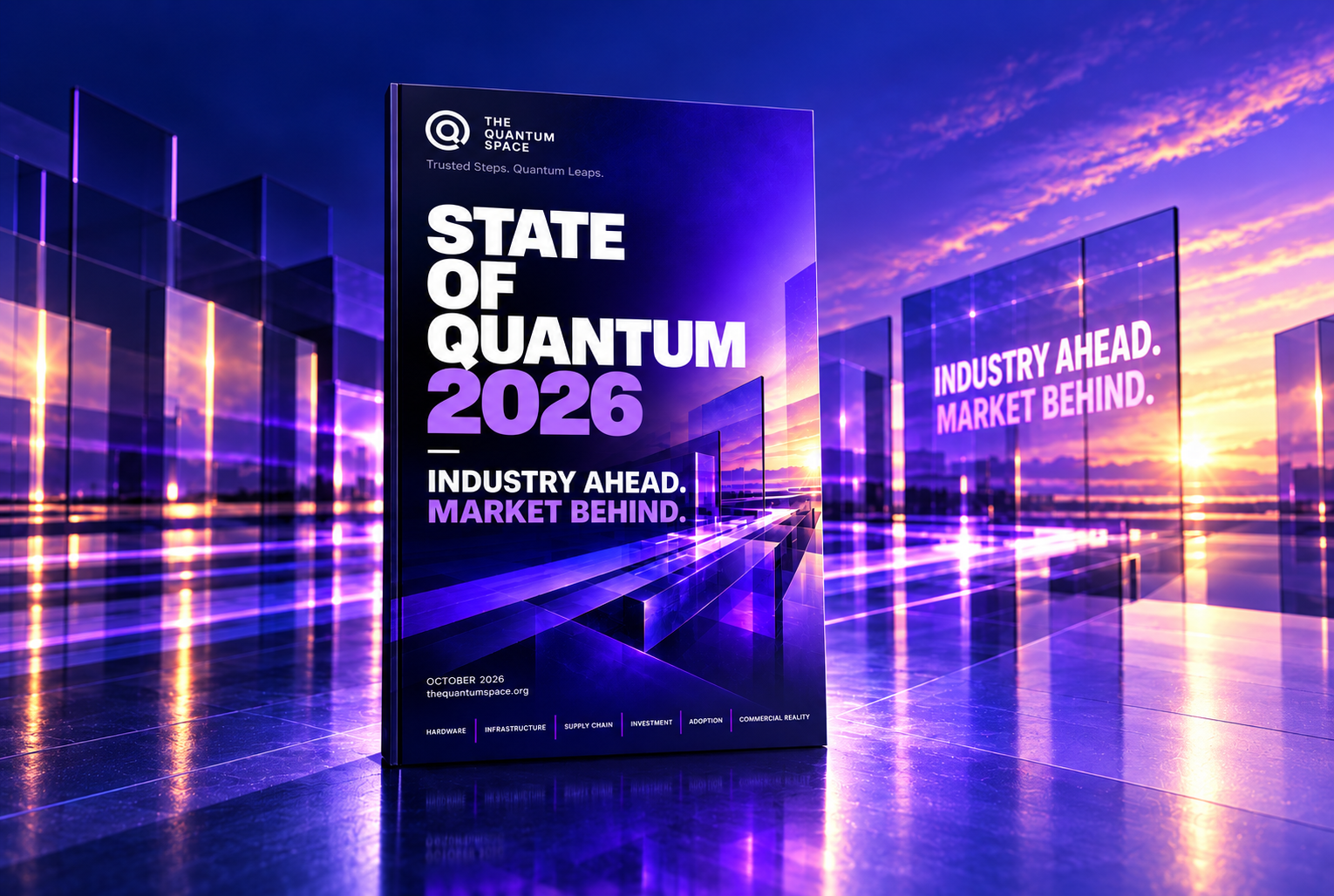
The Quantum Space today publishes State of Quantum 2026, a new report examining the progress of quantum computing across hardware development, industrial infrastructure, global supply chains, investment and commercial adoption. As the industry moves beyond laboratory research towards real-world deployment, the findings reveal a growing industrial ecosystem facing a more demanding commercial reality.
Quantum computing is entering a new phase of development. After years in which progress was measured primarily through scientific breakthroughs, processor specifications and ambitious technology roadmaps, the industry is increasingly demonstrating the characteristics of an established industrial sector. Commercial systems are being manufactured and delivered, national computing infrastructure is expanding, international supply chains are taking shape and investment continues to support the development of new capabilities.
But beneath this progress lies a question that is becoming increasingly difficult to ignore. While the industrial foundations of quantum computing are developing rapidly, the commercial market that must ultimately sustain them remains at a much earlier stage of maturity.
This is the central finding explored in State of Quantum 2026, a new 16-page report published today by The Quantum Space. Bringing together industry data, company results, recent research and examples of emerging applications, the report provides an evidence-based assessment of where quantum computing stands in October 2026 and the developments likely to shape its progress into 2027.
An industry moving beyond the laboratory
One of the clearest indications of quantum computing’s industrial progress is the increasing availability of complete commercial systems. Hardware manufacturers are moving beyond experimental prototypes to equipment that can be purchased, installed, integrated and supported within customer environments.
The report examines the development of hardware from companies including IBM, IQM and D-Wave, alongside the growing importance of different quantum computing architectures. It also considers the emerging distinction between technical performance and practical usefulness, particularly as developers concentrate on fault tolerance, error correction and the integration of quantum systems with classical computing infrastructure.
Evidence of industrial progress is becoming increasingly tangible. Finnish quantum computing company IQM reported that it had sold 26 quantum systems and delivered 17 by the end of June 2026, representing cumulative activity since the company’s founding. Meanwhile, European initiatives such as EuroHPC are expanding access to quantum computing through publicly funded infrastructure and procurement programmes.
These developments demonstrate that quantum hardware has become a deliverable commercial product. However, the presence of equipment in research institutions, national facilities and early enterprise environments does not automatically establish that a broad, self-sustaining market has emerged.
Building a global quantum industry
The report also examines the increasingly international character of quantum computing, drawing on recent research involving 160 quantum companies headquartered across 15 countries.
The findings illustrate the extent to which the industry already depends on international relationships. Ninety percent of the companies surveyed reported using at least one foreign supplier, while 74% had customers outside their home country. Across the study, suppliers were identified in 36 countries, manufacturing activities in 25 and customers in 49.
These figures highlight an important challenge for governments seeking to establish national quantum capabilities. Although quantum technologies have become strategically significant, the systems themselves depend on highly specialised components, materials, manufacturing processes and expertise distributed across international markets.
As quantum computing moves towards greater industrial scale, access to these capabilities will become an increasingly important factor in determining which companies and countries can translate scientific expertise into commercially competitive products.
Investment is accelerating. Commercial conversion takes longer.
Perhaps the most striking contrast identified in State of Quantum 2026 concerns the relationship between investment and market development.
According to figures compiled by the Quantum Economic Development Consortium, governments announced $12.7 billion in new quantum technology funding commitments during 2025, while private venture capital investment reached $4.9 billion. By the end of that year, cumulative announced government funding commitments had reached approximately $56.7 billion.
Against this backdrop, the estimated global market for quantum computing and sensing stood at approximately $1.9 billion in 2025, with quantum computing accounting for around $1.4 billion.
These figures represent different financial measures and cannot be compared as a direct calculation of investment returns. Nevertheless, they illustrate the distinction between capital being committed to building future industrial capacity and the commercial revenues being generated by the market today.
The report examines this relationship through company financial results, procurement activity and the developing commercial models of quantum hardware manufacturers. It highlights why orders, contracted projects, system deliveries and recognised revenue need to be understood separately when assessing the industry’s economic development.
Significant investment is helping to create the foundations of a future quantum market. The more difficult task will be converting those capabilities into sustained demand, repeat customers and measurable commercial value.
Early applications are providing evidence of value
While widespread commercial adoption remains limited, practical applications are beginning to emerge, particularly where quantum technologies can be combined with established classical computing and AI capabilities.
The report highlights work involving Schneider Electric and Silicon Quantum Computing in energy forecasting, where company-reported experimental results demonstrated an average improvement of approximately 20% in next-day forecasting accuracy against the project’s classical benchmark, with selected improvements reaching 41%.
The project provides an example of the potential for quantum approaches to contribute to specific industrial challenges. Its next stage will extend the research to hundreds of Australian homes, exploring how the technology can be incorporated into wider energy forecasting and AI workflows.
Such developments are important because they begin to connect quantum computing with measurable outcomes. However, improvements achieved within controlled experiments must still be evaluated against operational costs, integration requirements and alternative approaches before they can establish a sustainable commercial advantage.
This distinction between technical achievement and economic value runs throughout the report.
What will determine the next stage?
State of Quantum 2026 concludes by identifying six areas to watch as the industry moves into 2027, including hardware scalability, customer deployments, industrial applications, supply-chain resilience, policy development and commercial investment.
The central question is whether the progress now visible across the industry can translate into wider operational adoption. More capable quantum systems, expanding infrastructure and increasing investment all contribute to this possibility, but the ultimate measure will be how effectively these capabilities address problems that customers are willing to pay to solve.
The report does not suggest that quantum computing lacks a commercial market. Revenue is being generated, systems are being delivered and early applications are producing encouraging results. Instead, it examines the maturity and sustainability of that market relative to the scale of industrial development already underway.
For technology providers, investors, policymakers and enterprise decision-makers, understanding this distinction is becoming increasingly important. The decisions being made today about infrastructure, partnerships, investment and technology adoption will influence how the quantum industry develops over the remainder of the decade.
State of Quantum 2026 — Industry Ahead. Market Behind. brings these developments together in a concise, infographic-led assessment of an industry moving from technological possibility towards commercial reality.
The complete 16-page report is available to read and download from The Quantum Space.
A companion episode of Innovating Trust, exploring the findings and their implications for the future of quantum computing, will be released on Thursday, 22 October.




Leave a Reply