
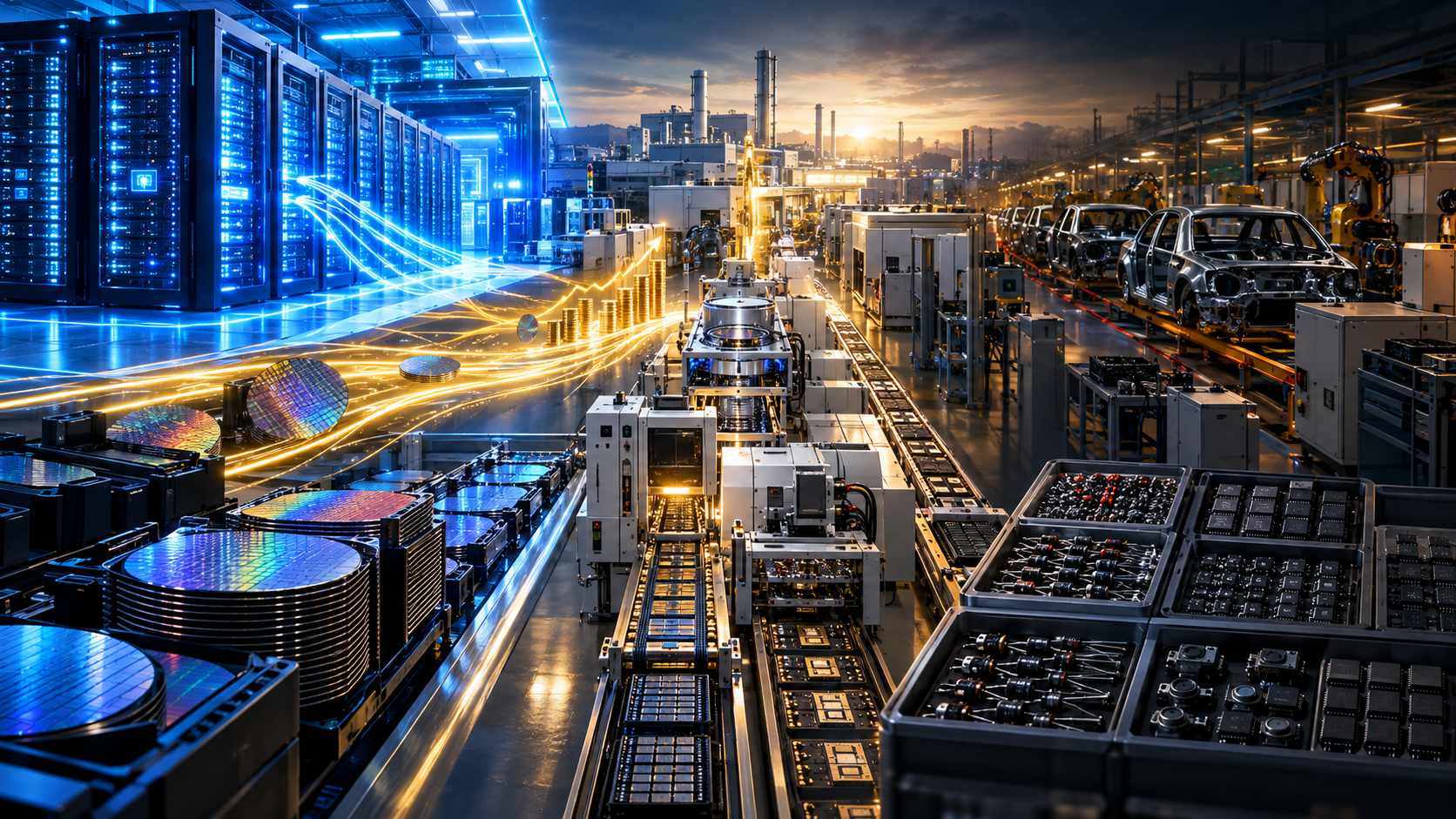
At electronica 2026, semiconductor executives warned that the rush to supply artificial intelligence infrastructure is creating bottlenecks for the automotive and industrial sectors. The problem is not simply a shortage of chips, but a changing economic balance within the industry that produces them. As investment follows AI’s higher margins, manufacturers of everyday electronic systems may find themselves competing for capacity, attention and long-term supply commitments.
The artificial intelligence boom has created extraordinary demand for computing infrastructure, with advanced processors, high-performance memory and data-centre systems becoming central to a global investment cycle. The semiconductor industry has benefited enormously from this expansion, but it is also beginning to confront an uncomfortable question: what happens to the rest of electronics when so much investment is concentrated on AI?
At electronica 2026 in Munich, executives from Nexperia and STMicroelectronics raised concerns about the effects of changing manufacturing priorities on the supply of conventional semiconductors. Speaking to Reuters on 10 November, Nexperia interim CEO Stefan Tilger described his company as heavily oversubscribed and warned that manufacturers were redirecting capacity towards more profitable AI-related applications. STMicroelectronics CEO Jean-Marc Chery also identified bottlenecks as semiconductor foundries and packaging companies increasingly prioritised products serving AI infrastructure rather than traditional automotive and industrial markets.
Their warnings point towards an important change in the economics of electronics manufacturing. The demand created by AI is not simply expanding the semiconductor industry; it is also influencing which technologies receive investment, which customers obtain production priority and which parts of the industrial economy may find their supply chains under increasing pressure.
The chips that rarely make the headlines
Public discussion of the semiconductor industry tends to concentrate on its most advanced products. The processors powering AI systems attract attention because of their extraordinary performance, technological complexity and commercial value. Investment in the fabrication technologies needed to manufacture them has consequently become a strategic priority for governments and technology companies.
Yet much of the industrial economy depends on considerably less glamorous components. Cars, industrial controllers, power supplies, factory equipment and connected devices rely on enormous quantities of conventional semiconductors, including diodes, transistors, analogue devices, power-management components and other established technologies. These products may have relatively modest individual prices, but they perform essential functions throughout complex electronic systems.
Many do not require the latest manufacturing processes. Mature semiconductor technologies remain appropriate because they offer particular electrical characteristics, established reliability and predictable production economics. Their relative simplicity does not make them expendable: a sophisticated automotive control system cannot operate correctly merely because its most advanced processor is available if an essential supporting component is missing. The same principle applies to industrial automation, medical equipment, communications infrastructure and other electronically controlled systems, where a low-cost semiconductor can become the critical dependency in a much more valuable product.
How AI changes the manufacturing equation
There is an important distinction in the warnings from electronica. Advanced AI processors and conventional industrial components are not necessarily produced using interchangeable manufacturing processes. A factory producing leading-edge AI chips cannot automatically replace every production line manufacturing mature semiconductor technologies, nor can existing facilities always switch between the two.
The competition is more complicated, involving decisions about capital expenditure, manufacturing priorities and the allocation of specialised resources. Semiconductor manufacturers, foundries and packaging specialists must determine where they expect demand to grow, which customers offer the strongest commercial returns and how their production capacity should develop over time.
AI infrastructure presents an unusually attractive opportunity. Its customers are making substantial commitments to computing capacity, and demand for high-performance components can justify significant investment in advanced manufacturing technologies. Products serving established industrial markets, particularly those offering lower margins or slower growth, may struggle to attract comparable investment. For some suppliers, expanding conventional component production can appear less attractive than directing additional resources towards AI-related applications.
Constraints can also arise beyond wafer fabrication. Packaging, assembly, testing and other manufacturing services are important parts of the supply chain, and different semiconductor products may compete for overlapping industrial capabilities even where their underlying fabrication processes differ. A bottleneck in one of these stages can affect the availability of finished components regardless of the capacity available elsewhere.
These decisions are commercially understandable. Individual companies invest where they anticipate the strongest returns, but their collective decisions can have consequences extending beyond individual businesses. An industry increasingly optimising capacity for its most profitable opportunities may leave other strategically important markets more exposed to disruption.
This does not mean that AI is responsible for every semiconductor shortage. Mature-node investment patterns, automotive demand cycles, geopolitical restrictions and supplier-specific difficulties also influence availability. The warning emerging from Munich is narrower but nevertheless significant: AI-related investment is becoming another factor shaping access to semiconductor manufacturing capacity and the wider supply chain.
Industrial resilience depends on ordinary components
The automotive and industrial sectors have already experienced the consequences of semiconductor supply-chain disruption. A complex product may depend on hundreds or thousands of electronic components sourced through international supplier networks, and manufacturers cannot always substitute an alternative device without redesigning circuits, revising software or repeating qualification procedures.
In some applications, replacement parts must satisfy demanding reliability and safety requirements. Equipment expected to operate for fifteen or twenty years presents an additional challenge because component availability becomes part of lifecycle management. A device that can be manufactured today may become difficult to maintain if an essential component disappears from production before the end of its intended operational life.
For industrial manufacturers, the consequences go beyond purchasing costs. A component shortage may delay production, while an unexpected change in sourcing can introduce new quality, security or certification considerations. A discontinued semiconductor may require expensive redesign work, particularly where the affected product is installed in a regulated or safety-critical environment.
This is also relevant to the wider discussion of industrial cybersecurity and resilience. Software integrity, secure communications and effective protection against cyberattacks receive considerable attention, as they should, but reliable operation also depends on continued access to the physical hardware on which those capabilities run. An industrial controller may be protected by sophisticated cryptography and regularly updated software, yet its long-term availability still depends on the manufacturer’s ability to obtain and support its underlying electronic components.
Supply-chain resilience consequently needs to account for both the digital and physical dependencies of connected systems. Protecting the software does not eliminate the need to secure the hardware supply chain, particularly where industrial equipment must remain operational for many years.
The economics of semiconductor sovereignty
The debate also raises questions for European industrial policy. Europe has placed considerable emphasis on strengthening semiconductor manufacturing capabilities and reducing strategic dependencies through public investment, industrial partnerships and efforts to expand domestic production.
The objective is understandable. Semiconductor supply chains are highly international, technologically specialised and exposed to geopolitical as well as commercial pressures. However, greater manufacturing capacity does not automatically provide resilience across every category of semiconductor.
A country may successfully attract investment in advanced chip manufacturing while remaining dependent on overseas production for conventional electronic components. Similarly, new fabrication facilities may not resolve constraints in packaging, testing or specialist materials, all of which can affect the availability of finished devices.
The warnings from electronica suggest that industrial resilience needs to be assessed across the entire manufacturing ecosystem. Policymakers and manufacturers need to understand which components are critical to essential industries, where production is concentrated, which technologies may be receiving insufficient investment and how easily customers can obtain qualified alternatives.
The answers will differ considerably between advanced processors, analogue components, power electronics and secure microcontrollers. A realistic industrial strategy must therefore distinguish between technological leadership in particular semiconductor categories and the broader ability to maintain dependable supplies for essential applications.
The objective does not necessarily need to be manufacturing every semiconductor within Europe. It should be understanding where concentration, limited capacity or fragile supplier relationships create unacceptable dependencies, and where targeted investment or supply diversification could improve resilience.
The paradox of industrial AI
There is a further irony in the changing relationship between AI investment and semiconductor supply. Automotive manufacturers, industrial equipment suppliers and factory operators are themselves investing in artificial intelligence, with machine vision, predictive maintenance, intelligent control systems and automated engineering among the applications expected to improve industrial productivity.
These applications depend on electronic infrastructure, including many of the conventional semiconductor components now attracting concern. If the expansion of AI data centres contributes to bottlenecks in the components needed to manufacture industrial equipment, the sector could face competing pressures. AI promises to improve productivity within established industries while the infrastructure supporting its rapid expansion may place additional demands on some of the supply chains those industries rely upon.
This is not an argument against AI investment, nor does it establish that the semiconductor industry is approaching a generalised shortage. It is an argument for examining the broader industrial consequences of where investment is directed and recognising that technological progress does not occur within isolated markets.
Manufacturing capacity, procurement priorities and capital expenditure decisions can affect industries that appear only indirectly connected to the technology attracting the investment. As the AI economy grows, those indirect effects are becoming increasingly important for companies whose products depend on secure, predictable access to electronic components.
What industrial customers should be asking
For companies purchasing semiconductors, the immediate implications concern supply-chain visibility and strategic procurement. Understanding a supplier’s current production capacity may no longer be sufficient if its future investment priorities could change the availability of particular components.
Customers increasingly need to understand whether essential product lines are receiving continued investment, whether packaging and testing capacity is secure and whether production could be redirected towards other markets. They also need credible commitments on long-term component availability, particularly where products require extended support or cannot be redesigned easily.
Manufacturers of connected and secure industrial products should consider these questions alongside software-maintenance commitments, cybersecurity requirements and component qualification. The ability to update firmware or migrate cryptographic algorithms is important, but so is the availability of the hardware on which those updates must operate.
These considerations are particularly relevant to industries implementing the EU Cyber Resilience Act, where product security and lifecycle responsibilities will require attention to technical dependencies over time. Although the Act does not establish semiconductor supply quotas, the broader obligation to maintain secure products makes dependable hardware support an important operational concern.
An industry with competing priorities
The warnings from electronica do not establish that artificial intelligence is consuming the entire semiconductor industry, nor do they prove that a generalised shortage of conventional chips is inevitable. They do, however, expose an emerging tension between the commercial incentives driving AI investment and the requirements of industries dependent on established semiconductor technologies.
Manufacturers are responding to demand and profitability, but the resulting allocation of investment and capacity may not always align with the wider industrial economy’s need for continuity and resilience. For policymakers, that means assessing semiconductor dependencies across technologies and supply-chain stages rather than concentrating solely on the most advanced processors. For industrial customers, it means treating component availability and supplier investment priorities as long-term operational risks.
The broader lesson is that innovation in one sector can create unexpected pressures elsewhere. The AI boom depends on semiconductors, but so does almost everything else. Ensuring that one industry’s extraordinary growth does not undermine the electronic foundations supporting the rest is becoming an increasingly important question for industrial strategy.


Leave a Reply