
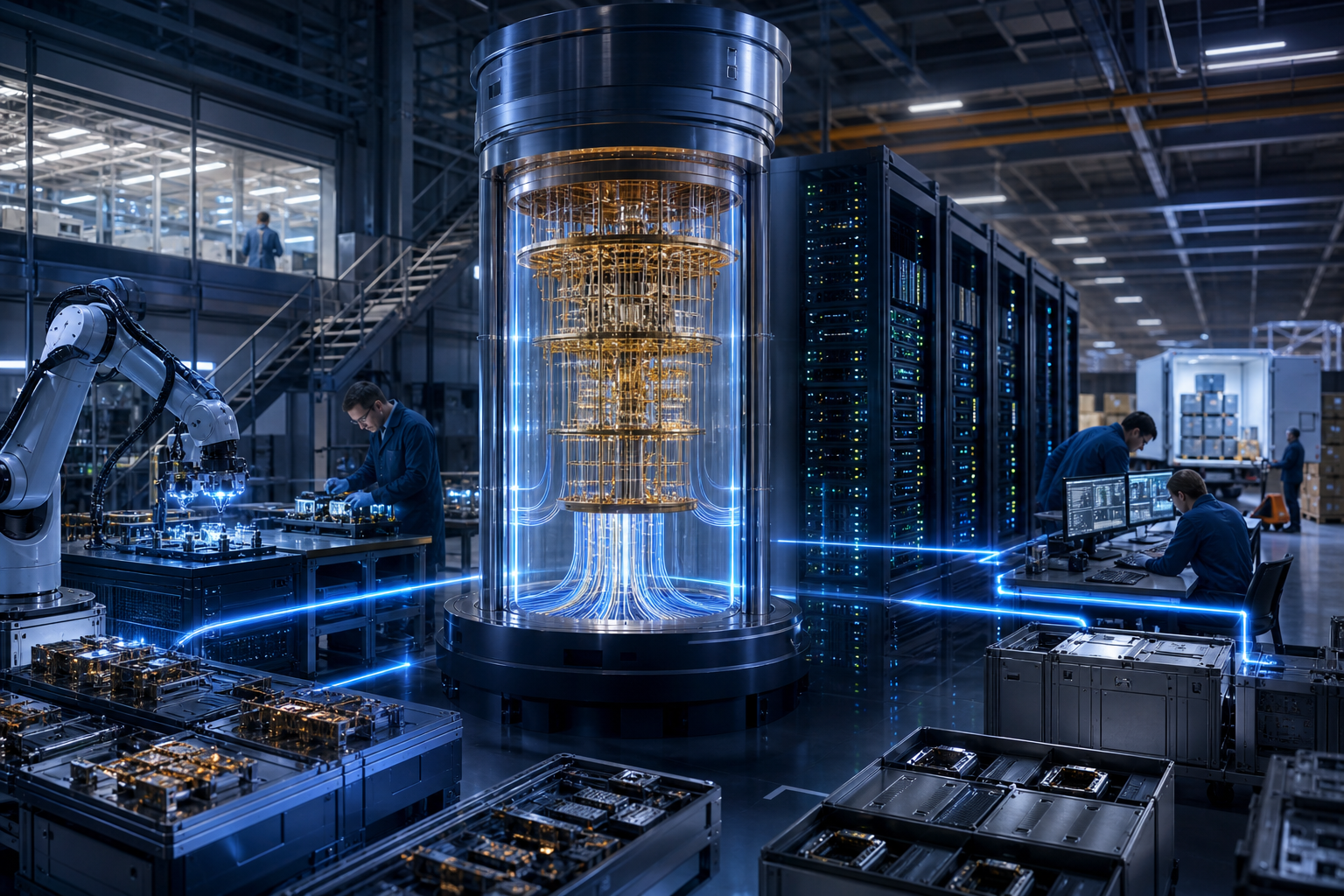
Quantum computing has spent years being measured through qubits, fidelity and scientific breakthroughs. Now another set of indicators is becoming important: cloud integration, manufacturing, supply chains and the infrastructure required to turn experimental machines into systems enterprises can actually use.
Quantum computing has spent most of its development phase proving that the underlying science can work. The next challenge is rather different: proving that the technology can be manufactured, deployed, integrated and operated at scale. That transition is beginning to become more visible, and two announcements from Quantinuum during August illustrate the change particularly well.
On 11 August, the company announced a multi-year partnership with Oracle that will place its Helios quantum computer inside a US-based Oracle Cloud Infrastructure AI data centre. Two days later, Quantinuum announced an agreement with Quanta Computer to develop the systems engineering, hardware infrastructure and manufacturing capabilities required for future large-scale quantum computers. Neither announcement changes the fundamental technical challenges still facing quantum computing, but together they show that companies are beginning to invest more seriously in the infrastructure required if quantum systems are to move beyond specialist research environments.
Quantum becomes part of the computing environment
The Oracle agreement is significant because of how Helios is expected to be used. Rather than being treated as a standalone quantum resource, the system will operate within Oracle Cloud Infrastructure alongside conventional high-performance computing and GPU infrastructure. OCI customers are expected to access Helios through an Oracle quantum service, with the system integrated into existing compute, networking, storage, identity and data services.
That matters because most enterprises are unlikely to operate quantum computers directly. The more realistic model is hybrid computing, where quantum processors perform specific parts of a workload while conventional CPUs, GPUs, HPC systems and increasingly AI platforms handle the rest. For that model to become useful, quantum resources have to fit into technology environments organisations already understand, with applications able to access data, developers working within familiar programming environments and security, governance and access controls remaining consistent across the wider architecture.
The significance of the Oracle partnership therefore lies less in providing remote access to quantum hardware and more in making quantum capability part of a broader enterprise computing environment. If every quantum deployment requires a separate architecture, a separate operating model and a specialist team, adoption will remain limited. If quantum capability can increasingly be consumed as part of existing cloud and HPC infrastructure, the barrier to experimentation and eventual deployment becomes considerably lower.
Manufacturing becomes part of the roadmap
The Quanta Computer partnership addresses scale from the opposite direction. Quanta is already one of the world’s largest manufacturers of computing and cloud infrastructure, and its agreement with Quantinuum is intended to jointly develop the hardware infrastructure, systems engineering and manufacturing capabilities required for future generations of quantum machines. Engineering work is already underway to make those systems more modular, manufacturable and scalable.
Those words are significant because they mark a different phase in the development of the technology. For most of quantum computing’s history, the main objective has understandably been to improve the machine itself: increasing fidelity, controlling more complex systems, developing error correction and demonstrating increasingly capable processors. Commercial scale introduces another test.
A quantum computer that can be assembled once by the scientists and engineers who designed it is not necessarily a system that can be manufactured repeatedly, installed predictably and supported economically. That requires standardised components, repeatable processes, industrial engineering, dependable supply chains and manufacturing capacity. Quantinuum CEO Rajeeb Hazra has described the objective as moving from breakthroughs in laboratory physics towards breakthroughs in systems manufacturing, and that distinction is becoming increasingly important as the industry looks beyond individual machines.
Quantum computing does not scale simply because the processor improves. The systems, manufacturing processes and supply chains around the processor have to scale with it.
From individual machines to an ecosystem
The Oracle and Quanta agreements are not happening in isolation. In June, Quantinuum announced a collaboration with HPE focused on integrating quantum computing with HPC and AI environments and engaging enterprise customers around hybrid quantum-classical applications. Taken together, the relationships with HPE, Oracle and Quanta begin to outline the infrastructure stack required for broader quantum deployment.
At the centre is the quantum processor and the considerable scientific work still required to improve it. Around that processor sit control systems, components, manufacturing processes and supply chains. Above it come cloud access, HPC, AI, software and development environments, with enterprise applications ultimately depending on all of those layers working together.
This matters because most businesses will not become quantum-computing companies themselves. They are more likely to consume quantum capability through cloud platforms, specialist providers, hybrid software environments and industry-specific applications. The easier those systems become to access and integrate, the less quantum computing has to be treated as a separate technological category and the more it begins to resemble another specialised component within a broader computing estate.
There are early commercial signals supporting that transition. Quantinuum reported second-quarter revenue of $8 million, up from $2 million in the equivalent quarter a year earlier, while also reporting increased developer activity and investment in manufacturing and supply-chain capabilities. Those figures still underline how early the market remains. An $8 million quarter is not evidence of mass enterprise adoption, and infrastructure investment should not be interpreted as proof that large-scale fault-tolerant quantum computing is imminent. What it does show is that companies are beginning to prepare for a market they expect to become larger.
Scale changes what matters
This shift may require a broader way of judging quantum progress. Hardware performance will remain fundamental because none of the surrounding infrastructure matters if quantum processors cannot eventually deliver useful computational advantage. But performance alone will not determine whether quantum computing becomes commercially significant.
Systems also have to be manufactured reliably, components must be sourced at sufficient volume, machines need to be installed and maintained, and developers need tools that fit existing workflows. Enterprises require secure access to quantum resources, and those resources have to integrate with classical and AI infrastructure rather than create an entirely separate technology estate.
As deployment increases, operational questions therefore become more important. Companies will need to know how easily systems can be maintained and upgraded, how consistently another machine can be manufactured, how much specialist expertise is required at the customer site and how quantum workloads can be incorporated into existing architectures. These questions receive considerably less attention than breakthroughs in quantum hardware, but they become unavoidable once an industry begins thinking seriously about scale.
Building beyond the processor
That is why the Oracle and Quanta announcements are worth watching together. One addresses how enterprises might eventually consume quantum computing, while the other addresses how increasingly complex quantum systems might be manufactured in sufficient numbers to support that demand. Neither proves that the commercial quantum market has arrived; instead, they suggest that the industry is beginning to prepare for what happens if it does.
For much of the past decade, the central challenge has been building a quantum computer capable of useful computation. That challenge remains, but another is now emerging alongside it: building an industry capable of delivering those machines repeatedly, integrating them into existing computing environments and supporting customers once they arrive.
Quantum computing is still building better machines. Increasingly, it is also beginning to build for scale.




Leave a Reply