
What Shunkai tells us about building a quantum computer people can use
Japan’s Shunkai brings single-atom qubits, optical controls and software together in one operational system. Doing away with a deep freezer changes what it takes to house a quantum computer. The harder test is whether the machine can run larger, more reliable calculations for researchers beyond the team that built it.
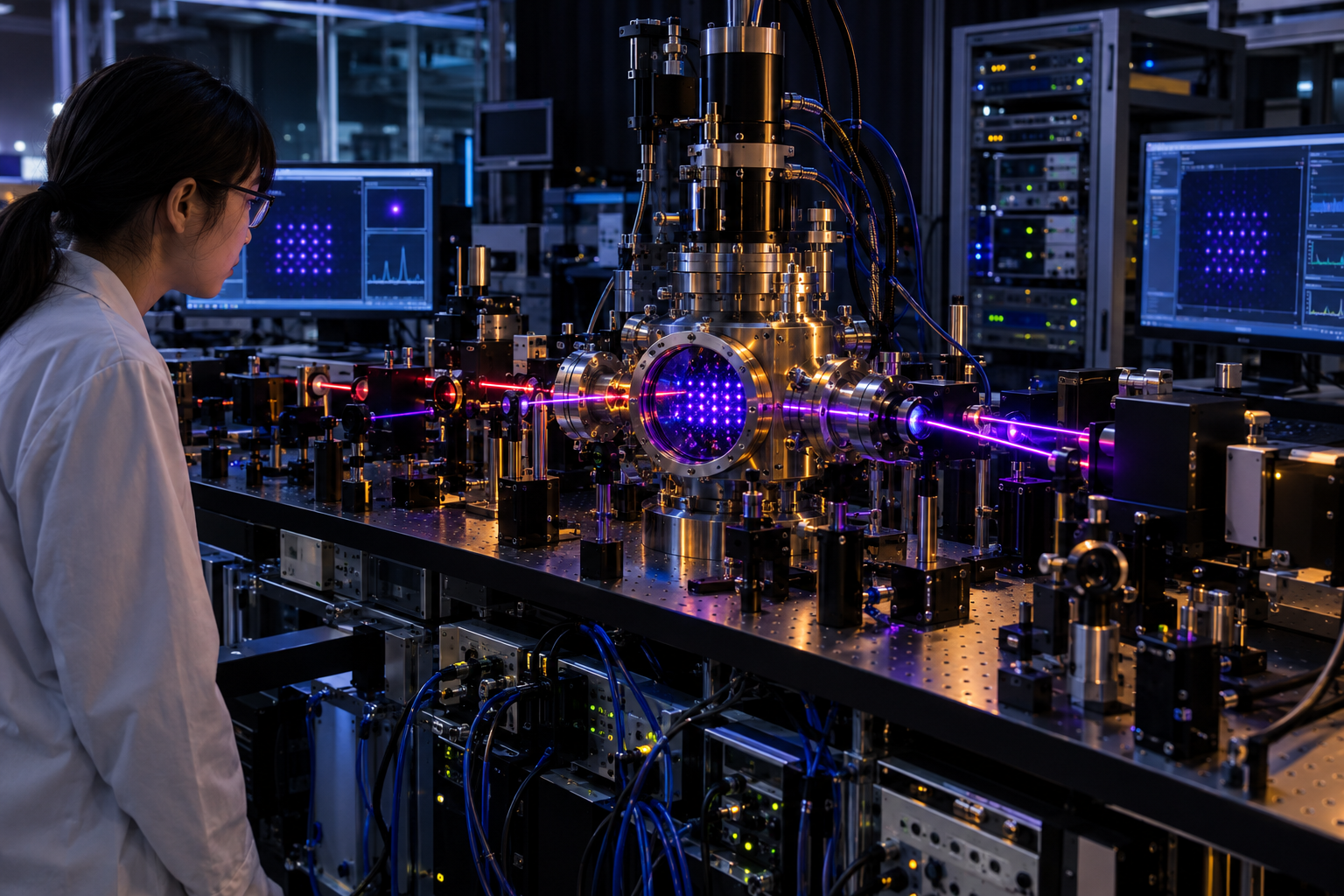
The most striking thing about Japan’s Shunkai quantum computer is what it can do without. Its processor needs no dilution refrigerator to reach the temperatures used by superconducting quantum machines. Instead, the computer traps individual atoms with laser light and uses those atoms as qubits. But take away the freezer and the engineering bill still has plenty of line items. The lasers have to hold and manipulate the atoms precisely, the controls have to translate a program into physical operations, and a camera has to read the result from the light emitted by each atom. In August, Japan’s Institute for Molecular Science (IMS) announced that it had brought those layers together in the country’s first operational full-stack neutral-atom quantum computer.
That makes Shunkai a useful follow-on to our State of Quantum report. A laboratory can show that a technique works under carefully controlled conditions. An integrated machine gives the team somewhere to find out how those techniques behave together, run after run. It also gives software researchers a chance to work with the hardware’s actual constraints. Those are different kinds of progress, and the second becomes increasingly important as the industry tries to turn its experiments into computing infrastructure.
The freezer goes. What takes its place?
In Shunkai, tightly focused beams of light act as optical tweezers, holding atoms in an array. Microwaves or laser light manipulate the atoms, and the machine reads the result by imaging their fluorescence. Neutral-atom systems can also move atoms around, which gives researchers more freedom over which qubits interact. That flexibility can matter when laying out a calculation or designing an error-correction scheme. Moving, controlling and reading more atoms reliably is itself an engineering challenge.
The economic question starts there. Dispensing with deep refrigeration changes the equipment and expertise a site needs. The cost of precision optics, calibration and stable operation still has to be accounted for. A research centre comparing machines would also want to know how much time users get for experiments, how often the system needs recalibration and how many usable runs it delivers in a day. Those figures would say more about the cost of doing research on Shunkai than the absence of a refrigerator can tell us on its own.
From 50 atoms to a useful calculation
IMS says Shunkai is intended to use about 50 qubits initially, with a planned expansion to around 500. The wider research programme aims to make a fault-tolerant neutral-atom computer with 10,000 physical qubits available to external users by March 2031. The August announcement establishes that Shunkai is operational. Its qubit figures describe the stages the team is working towards. The release gives no results for repeated error correction, sustained availability or an application benchmark on Shunkai itself.
The distinction between physical and logical qubits matters here. Each trapped atom is a physical qubit. A logical qubit encodes quantum information across multiple physical qubits so errors can be detected and, within the limits of the code, corrected. A larger array gives the team more room to do that work. To show that the extra atoms translate into better computing, the team will need to demonstrate that the encoded information can survive more operations and that increasing the protection brings the error rate down. Peer-reviewed neutral-atom research has already demonstrated below-threshold error correction on a separate system, giving Shunkai a concrete benchmark to work towards.
Who builds the stack matters
IMS led the project under Japan’s publicly funded Moonshot programme. Hitachi contributed the software stack, while US-based Infleqtion contributed the quantum processing unit stack. The result gives Japan an operational system around which its researchers can develop software, experiment with control techniques and test error correction. It also puts a foreign partner at a critical layer of the machine.
That makes Shunkai a more interesting sovereignty story than a tally of domestic components. For a research programme, control also means being able to inspect how the machine behaves, modify the software, diagnose failures and keep the system running through successive upgrades. Which of those capabilities sit with the research institute, which sit with its partners, and how easily could a component be replaced? The announcement identifies who built each layer. It leaves those longer-term operating questions open.
The next milestone is someone else’s experiment
IMS plans to give external users partial access to Shunkai for application development and error-correction work. It has also raised the prospect of connecting the machine to its shared supercomputing facility as part of a quantum–GPU hybrid centre. External access would give researchers outside the project a chance to test how easily they can submit jobs, reproduce results and work around the machine’s limitations. A connection to classical computing would let them explore where a quantum processor fits into a wider workflow. Both are plans worth following as the system develops.
Getting Shunkai running gives Japan somewhere to do that work. The next result worth watching is what happens when a team that didn’t build the machine comes with a calculation of its own. Can it run the job, understand the result and reproduce it a week later? That’s when we’ll start to see what kind of research instrument Japan has built.


Leave a Reply