

Anthropic’s latest Claude model illustrates how artificial intelligence is changing the economics of software. As AI services move towards increasingly sophisticated, autonomous workloads, customers must manage not only access to technology but also how much of it is consumed, by whom and at what cost. The resulting questions about usage, allowances and control extend well beyond AI and into the wider evolution of software licensing.
For decades, much of the enterprise software market has operated around a relatively straightforward commercial principle. An organisation purchases access to software, usually through a licence, subscription or agreement covering a defined number of users. The contractual arrangements may be complicated, but the basic unit of value is generally understandable and the customer’s financial commitment can often be established in advance.
Artificial intelligence is changing that relationship because the resources needed to complete a task can vary enormously. A simple request may take seconds and consume relatively few computing resources, while a complicated engineering assignment could require extensive context, repeated analysis, multiple tool interactions and a series of increasingly demanding computational steps.
The same user can therefore generate very different operating costs depending on what the system is asked to accomplish and how it chooses to approach the task. This variability is helping consumption-based pricing become an increasingly important part of the AI economy, particularly as organisations move from occasional experimentation towards operational deployment.
Anthropic’s release of Claude Fable 5.2 on 9 November provides a useful example. The company prices standard API access at $8 per million input tokens and $40 per million output tokens, with additional arrangements covering features such as caching, batch processing and faster execution. These figures provide developers and enterprise customers with a measurable basis for calculating usage costs, but they also raise a broader question about what happens when software expenditure depends increasingly on what the system does rather than simply who has permission to use it.
A token is not a unit of business value
In an AI model, a token represents a unit of information processed or generated by the system. Text is divided into tokens according to the model’s tokenisation process, with the relationship between tokens and words varying according to language, formatting and content.
For commercial purposes, tokens provide a convenient and measurable unit of computational activity. They do not, however, provide a direct measure of business value. A customer might consume thousands of tokens generating material that ultimately proves unusable, while another might achieve a valuable result through a relatively small interaction.
This distinction matters because usage-based pricing measures what the system processes, not necessarily the benefit delivered to the customer. Similar models have existed for years in cloud computing, telecommunications and other technology services, but AI introduces additional complexity because resource consumption can depend on the behaviour of the software itself.
A conventional application may execute a relatively predictable operation in response to a user command. An AI agent might decide that completing the same assignment requires additional searches, more analysis, repeated code execution or further interactions with external systems. Those activities can increase consumption without the user explicitly requesting each individual step.
The more autonomy an AI system receives, the more important it becomes to understand how that consumption is governed. Organisations must be able to distinguish between computational work that contributes to a valuable result and activity that increases costs without providing a corresponding benefit.
When the software decides how much work to do
Consider an enterprise using AI to examine a substantial collection of technical documents. The system may retrieve information, compare findings, identify contradictions and prepare a consolidated analysis, potentially involving numerous model requests rather than a single interaction.
If the AI agent is permitted to investigate uncertainties independently, it may extend its analysis further by consulting additional sources or running more complex evaluations. In some circumstances, that additional work could improve the result considerably. In others, it might add expense without producing a meaningful improvement in quality.
The commercial problem is therefore not simply whether the technology is affordable. It is whether the customer understands and controls the relationship between computational effort, expenditure and the outcome achieved.
That requires more than publishing a price per million tokens. Organisations need to determine who can initiate demanding workloads, what limits apply and when additional usage should require authorisation. They also need reliable information about how consumption is recorded, attributed and reported.
Without these controls, AI expenditure can become difficult to forecast, particularly when usage spreads across multiple departments, automated workflows and applications that incorporate AI services through programming interfaces.
Access and consumption are becoming separate decisions
Anthropic’s enterprise arrangements illustrate how these questions are appearing in commercial software. Its usage-based Enterprise model separates the cost of a user’s seat from the cost of the model consumption that follows, allowing access and usage to be managed as distinct elements of the customer relationship.
In self-service Enterprise arrangements, organisations purchase credits that are shared across users. Consumption reduces the available balance, and service can stop when those credits are exhausted unless additional credits are purchased. Other enterprise billing arrangements charge for consumption retrospectively, while some existing Team and seat-based Enterprise plans include usage allowances that can be supplemented through additional credits.
These arrangements should not be treated as interchangeable, but they demonstrate a significant evolution. Permission to access software and permission to consume resources are becoming separate commercial decisions, requiring corresponding technical controls.
A user may have access to an AI service but only a limited allowance for certain activities. A department might operate within a shared consumption budget, while a business could permit routine use automatically but require additional authorisation for particularly expensive operations.
The technology provider must implement those rules, and the customer must be able to understand and manage them. A spending limit that exists only in a contract but cannot be reliably enforced within the software offers limited operational protection.
The governance question behind the meter
Consumption controls are frequently discussed as a financial concern, but they are also becoming an important aspect of governance. When organisations introduce autonomous AI systems into operational processes, those systems may initiate activities that consume resources, invoke external services or create further workloads.
Cost is one consequence of granting those capabilities, but the wider questions concern authority and accountability. Organisations must understand who authorised a particular system to perform an activity, which limits were established, how those limits are enforced and what happens when the system attempts to exceed them.
These considerations become more significant as AI applications move beyond generating information and begin interacting with operational systems. An AI agent that can undertake a complex engineering task, for example, may also be able to access costly computing services, initiate additional analysis or use external commercial tools.
A well-managed environment could establish separate allowances for experimentation and production workloads, require approval for high-cost activities or restrict particular models to authorised users. Usage data could also help identify unexpected patterns, inefficient workflows or errors that cause an AI system to repeat tasks unnecessarily.
Such controls do not guarantee that AI expenditure will correspond to business value. They do, however, make expenditure more visible and establish a framework for accountability as software becomes increasingly autonomous.
One word, several different meanings
The word token introduces an interesting connection with the wider software industry, although it is important to recognise that the same term can describe very different mechanisms.
In AI, a token generally represents a unit of information processed by a model. In software licensing, however, a token may represent a commercial entitlement, a consumable unit of value, a portion of a shared capacity pool or a quota replenished according to agreed conditions.
An AI processing token measures model activity, while a licensing token can represent a right to access or consume a software capability. These are distinct technical and commercial concepts, and treating them as equivalent would obscure the issues involved.
The connection becomes clearer when examining how organisations manage the commercial use of increasingly sophisticated software.
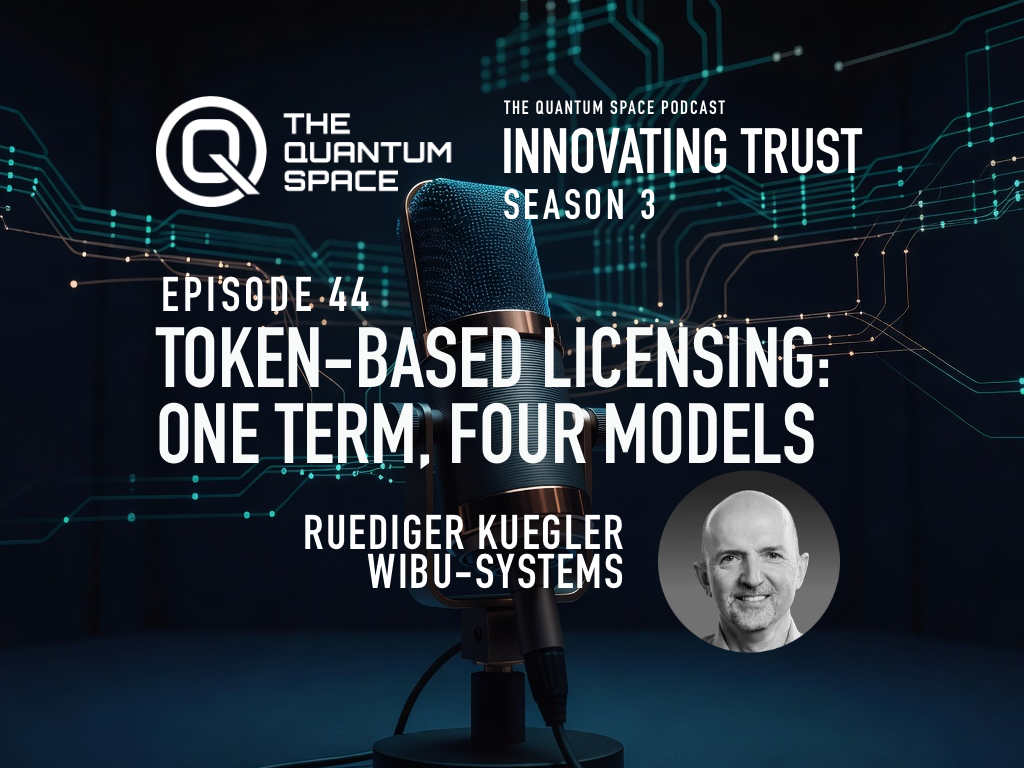
In preparing this week’s Innovating Trust podcast, we spoke with Rüdiger Kügler of Wibu-Systems about the different meanings of tokens in software licensing and how those models affect the relationship between vendors and customers. Our discussion, which forms the basis of Thursday’s episode, Token-based Licensing: One Term, Four Tokens, explores consumable entitlements, shared token pools, replenishing quotas and the technical mechanisms used to enforce licensing rights.
Although these mechanisms are different from the tokens processed by AI models, the conversation provides a useful perspective on the wider challenge of allocating, measuring and controlling software usage. The underlying commercial questions are becoming increasingly relevant as AI applications move towards more complex, consumption-based business models.
Software licensing has dealt with many aspects of metering and entitlement management for years. AI may be introducing new forms of resource consumption, but it is also drawing attention to established disciplines that can help organisations understand how software rights and usage are controlled.
From licensing agreements to operational control
Traditional licensing models frequently establish contractual rights that remain relatively stable during an agreed period. Usage-based arrangements introduce a more dynamic relationship in which consumption may change continuously and the system must determine whether activity remains within the customer’s commercial permissions.
This creates requirements for accurate metering, entitlement management, reporting and enforcement. It also raises questions about what happens when the infrastructure supporting those controls becomes unavailable.
Can a system continue operating temporarily without contacting a licensing server? Can consumption be recorded locally and reconciled later? What happens when a quota is exhausted during an essential operation, particularly where interruption could affect a manufacturing process or another critical service?
These questions are familiar in industrial software and embedded systems, where operational continuity cannot always depend on a permanent network connection. They also apply, in different circumstances, to enterprise AI services that support important business processes.
An organisation may not want a critical automated workflow to stop unexpectedly because a consumption allowance has been exhausted. Equally, it may not want the same system to continue generating charges without meaningful limits.
Resolving that tension requires deliberate choices about service continuity, spending authority and the consequences of exceeding agreed allowances. The appropriate solution depends on the importance of the workload, the customer’s risk tolerance and the economic relationship between provider and user.
These are precisely the kinds of commercial and technical considerations that become more important when software consumption is measured dynamically rather than being determined solely by the number of licences purchased.
What are customers actually buying?
The evolution of AI pricing invites a more fundamental question about the value of software. Are customers buying access to intelligence, purchasing computing capacity or paying for completed work?
Today, much of the answer is expressed through subscriptions and resource consumption. Yet those measures are imperfect proxies for the outcomes customers ultimately want. An organisation does not deploy AI merely to consume tokens. It expects the technology to improve productivity, accelerate research, reduce operational effort or deliver some other measurable benefit.
As AI becomes more deeply integrated into enterprise processes, customers may become more demanding about the relationship between charges and results. Providers could respond through different combinations of subscriptions, usage allowances, consumption fees and outcome-based commercial models. Even where pricing changes, the underlying need for technical control remains. Someone must define the rights available to a user or system, record the resources consumed and enforce the agreed conditions.
The sophistication of that infrastructure may become an important competitive factor. A provider offering predictable costs, transparent reporting and flexible usage controls could have an advantage over one whose technology performs impressively but proves difficult to govern commercially. For enterprise customers, the ability to understand and control consumption is therefore likely to become an increasingly important part of evaluating AI services.
The next question for enterprise AI
Anthropic’s latest model provides another example of the increasing sophistication of AI capabilities. But the wider significance of its pricing lies in what consumption-based economics reveal about the changing relationship between software providers and their customers.
As AI systems undertake longer and more autonomous assignments, resource consumption becomes less predictable and potentially more significant. Commercial permissions, technical enforcement and organisational accountability must consequently develop alongside the capabilities of the technology.
The challenge is to ensure that the ability to use powerful software remains aligned with the authority to incur the costs and consequences of using it. AI processing tokens and software licensing tokens may represent entirely different things, but the questions surrounding them are increasingly connected. Organisations must determine who is entitled to use a capability, how much can be consumed, who controls the limits and who is responsible when those limits are reached or exceeded.
As AI becomes part of operational infrastructure, the answers will matter alongside improvements in model performance. The commercial future of intelligent software will depend not only on what the technology can accomplish, but also on whether customers can understand, control and justify the resources it consumes.


Leave a Reply